
Most event teams don’t realize they bought the wrong hotel reservation software until the event is halfway through. The booking site looks fine. Online bookings come in. The dashboard shows reasonable numbers.
Then reconciliation week arrives, the pickup report doesn't match the rooming list, double bookings surface in the rooming list, a team books outside the block, and a housing contract quietly loses a five-figure commission.
That’s the gap this article exists to close. Choosing the best platform for an event is about picking the platform that solves the specific job you need it to do, whether that’s full event housing lifecycle management across hotel operations at scale, Stay to Play compliance for youth sports tournaments, or post-block overflow for an association whose annual convention always exceeds its contracted block.
For associations, the right hotel reservation software is the one that captures convention overflow instead of sending members to book on their own.
A hotel reservation system built for corporate business travel is a different product than one built for youth sports tournaments or citywide conferences. Vacation rental platforms are a different category entirely, with their own inventory model and channel management workflow, and fall outside the scope of this review. The consequences of mixing any of these categories show up in commission revenue, guest satisfaction, and the amount of manual work a team ends up doing.
Below is a ranked review of ten hotel reservation software platforms, evaluated against the same eight-factor framework and scored on how well they handle the realities of event housing, group travel bookings, and hotel management at scale. The goal is to help readers match the right tool to the right problem.
Readers sourcing rooms for a single event rather than running a housing portfolio can start with the companion review of group hotel booking platforms, which narrows the field to tools built for group reservations.
Every tool in this review was scored against EventPipe's reservation software review methodology, the same eight-factor framework applied to every hotel reservation platform evaluated on this site, including EventPipe. The methodology is published in full, applies consistently across listicles, and is designed to be neutral across different platform architectures (contracted blocks, live inventory, hybrid, direct property management system).
The eight factors and their weighting, covering the full arc from inventory management through reconciliation:
The table below maps score ranges to what they signal about a platform's fit:
Every review includes a "Best For" classification that describes the buyer scenario the tool is designed to fit. A score of 68 is not a quality judgment against an 85. It reflects how the platform performs against a specific eight-factor framework weighted toward full-lifecycle event housing workflows.
A platform purpose-built for a narrower use case (live instant booking, RFP sourcing) will score lower against this framework than a platform purpose-built for the full lifecycle, and that difference in score doesn’t mean the purpose-built tool is an inferior product. Readers should match scenario to "Best For" classification, then use the score for relative positioning.
All software characterizations in this article are based on publicly available documentation and marketing materials at time of writing. Feature sets evolve across the hotel software space, and readers are encouraged to verify current capabilities directly with each vendor.
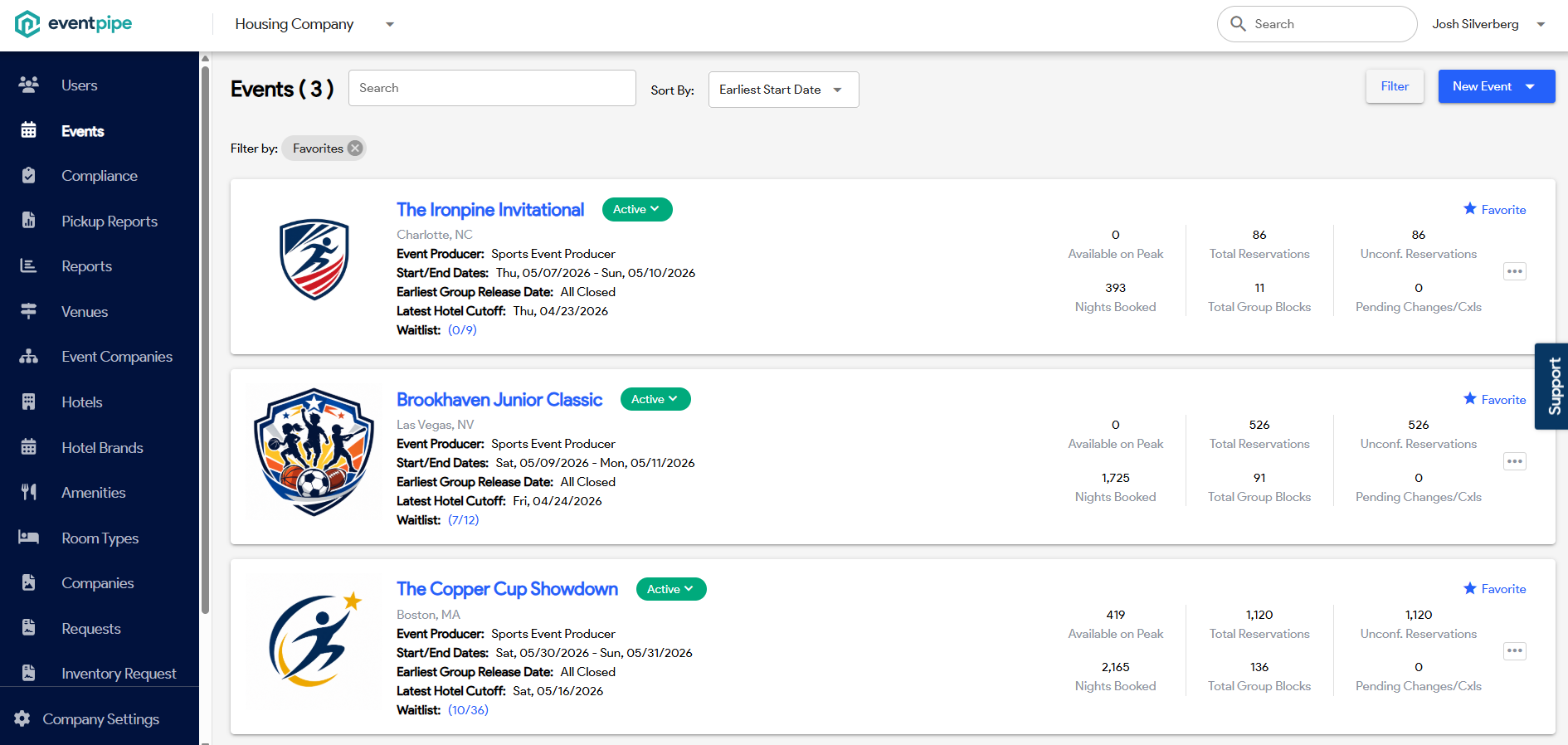
EventPipe is a SaaS platform purpose-built for event housing and accommodation management. Founded by Mike Adessa, whose family runs one of New England's largest high school hockey tournaments (Hockey Night in Boston), the platform was designed from firsthand experience with a gap no software was filling: efficient hotel room block management for large-scale events, mostly in the youth sports space, but expanding into new industries in real-time. EventPipe has powered over $1 billion in hotel bookings, including online bookings across major tournaments, and is the Official Housing Software Provider of Sports ETA.
Where most hotel reservation software solves one slice of the housing workflow, EventPipe covers the full lifecycle in a single system of record, from hotel identification and RFP management through booking site delivery, pickup reconciliation, and final invoicing.
A capable room block management system is what keeps pickup, inventory, and reconciliation aligned across every hotel in the event.
Best For: Best fit for youth sports housing companies, associations, wedding planners, festivals, event producers, sports commissions, and CVBs who need to manage the full event housing lifecycle end to end in a single system. Especially well-matched for youth sports housing companies who need stay-to-play compliance across multiple tournaments, and for associations whose annual conventions regularly overflow their contracted blocks.
Most hotel reservation software solves one stage of the housing workflow well and leaves the rest to spreadsheets and email. The cost of that gap shows up at reconciliation, when data handoffs between existing systems introduce errors, double bookings, and mismatches that quietly drain commission revenue.
EventPipe addresses this by covering the entire lifecycle in a single system of record, which means the RFP terms negotiated in week one flow into the contract, the direct bookings site, the pickup report, and the invoice. That continuity is what separates a full hotel reservation system from a collection of point tools.
The practical impact shows up in customer growth. Stack Sports (TeamINN) grew 80% year-over-year after adopting EventPipe, driven by faster event launches, stronger hotel relationships, smoother hotel operations across their portfolio, and configurable fee and deposit settings that turned the booking process into a revenue lever rather than a bottleneck.
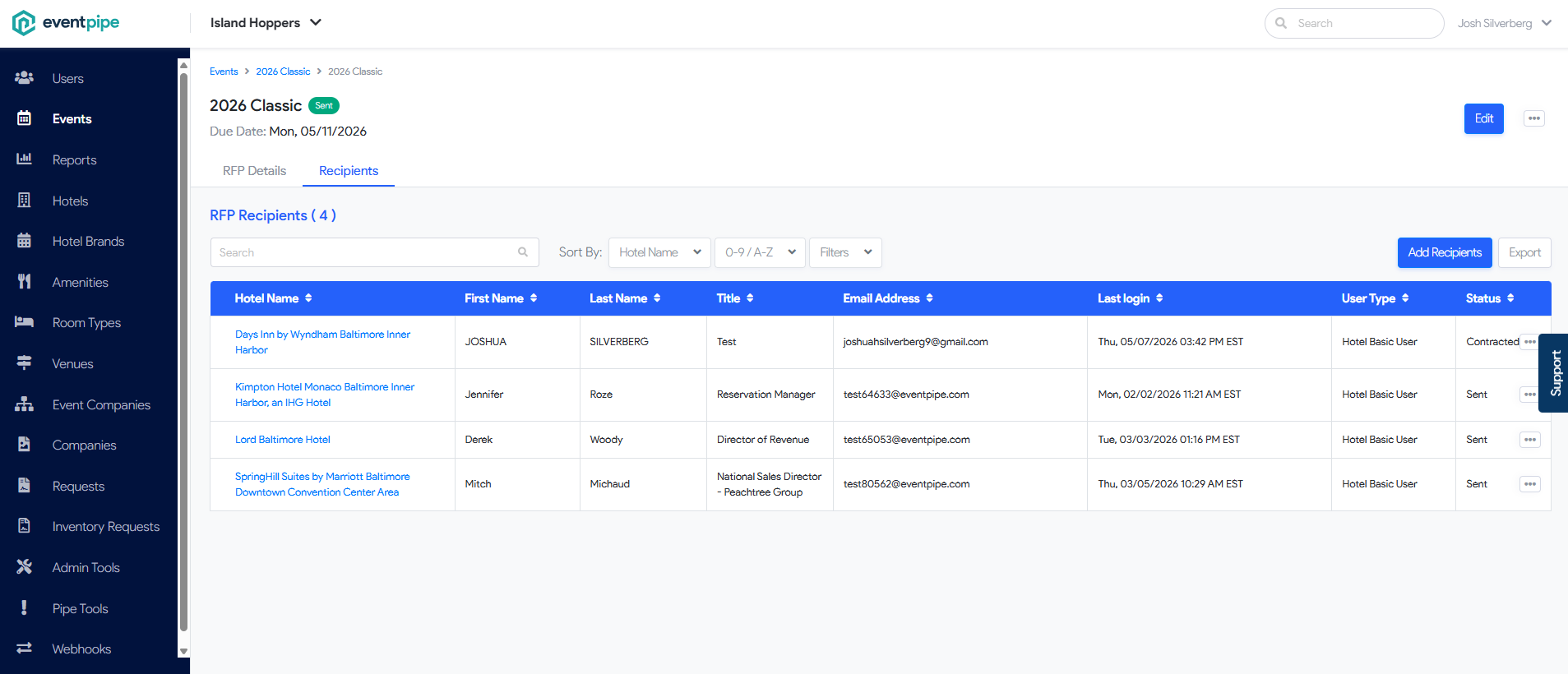
EventPipe integrates natively with major youth sports registration platforms including SportsEngine, LeagueApps, StackTourney, and TeamSnap for end-to-end guest management. That depth is part of why housing companies stay on the platform across multiple tournament seasons as they manage bookings season after season.
The platform also connects with each hotel's property management system for rooming list transfer and confirmation number upload. Data security is enterprise-grade: SSAE 16, ISO 27001, and PCI DSS compliant, with AES-256 encryption at rest and TLS/HTTPS in transit.
EventPipe uses a reservation-based subscription model. Customers commit to an annual reservation volume upfront, with pay-as-you-go overages above the committed threshold. Pricing is consultative and scales with the reservation system usage. Contact EventPipe directly for a quote tailored to event volume and feature set.
See how EventPipe handles the full event housing lifecycle: Request a demo

Paula Gravatt founded JPG Travel Solutions to specialize in hotel management for sporting events. In her first year, she was building rooming lists by hand across multiple spreadsheets and stitching together different systems to track bookings. The manual workflow capped how many groups she could take on.
Paula didn't know event housing software existed as a category until she found EventPipe. After adopting the platform, three capabilities stood out: a contracting workflow that turned what she called "a nightmare" into a simple, professional process, real-time pickup tracking that let her answer client questions and forecast profits without waiting for reconciliation, and branded booking sites that let attendees filter hotels based on what mattered to them.
"Contracting has become super simple and streamlined for me. Before EventPipe, contracting was a nightmare. It's now simple and professional."
Paula Gravatt, Owner, JPG Travel Solutions
Cvent Passkey is the housing module of Cvent, the event management platform used by 70% of Fortune 500 companies and credited with managing over 8 million events. Passkey sits inside the broader Cvent ecosystem and is most effective when used alongside Cvent Event Management for registration and other event workflows. It is built primarily for large-scale enterprise conferences, citywide events, and association conventions where attendees book within a contracted block after registering for the event.
Best For: Best fit for large enterprises, associations, and conference organizers who need housing tightly integrated with event registration across the Cvent ecosystem, especially those who need complex sub-block management for citywide events with 2,000+ attendees. Organizations already using Cvent Event Management will find Passkey a natural complement.
Passkey's strength is the depth of its sub-block management, its real-time room availability tracking, and its tight integration with Cvent's broader event platform. For large associations and corporate events where hundreds of sub-blocks need to be assigned across VIPs, speakers, internal staff, and exhibitors, the platform is purpose-built for that complexity. The trade-off is scope: Passkey is primarily a housing module, and the RFP, contracting, and hotel sourcing workflows live primarily in Cvent's Supplier Network rather than in an integrated RFP-to-contract system within Passkey itself.
The platform's architectural maturity is both a strength and a trade-off: long-running enterprise deployments give Passkey deep workflow capability, but the user interface and booking experience reflect the platform's legacy more than the modern, mobile-first defaults that newer housing platforms have built around.
Based on publicly available documentation, Passkey is most commonly deployed by organizations already using Cvent Event Management. Organizations that use Passkey standalone to manage bookings without the broader Cvent platform represent a smaller portion of Passkey's install base.
Native integration with Cvent Event Management through the Event Connector API. Direct integration into each hotel's property management system. Additional integrations available through the Cvent Supplier Network and partner platforms including Accelevents.
Pricing is not publicly listed. Passkey pricing typically scales with the broader Cvent contract and depends on event volume, Cvent module usage, and organizational scope. Contact Cvent directly for current pricing.
G2: 4.5 stars out of 5 - 53 ratings
Damla B says: “I really like the ease of search that Cvent Supplier & Venue Solutions offers, which significantly streamlines the process of finding suitable venues for our conferences and bespoke events. The ability to quickly find alternatives and compare them is fantastic, and it saves me a lot of time and effort. Additionally, the search engine is robust and effective, allowing me to view multiple options at once. I also appreciate the capability to contact suppliers directly through the platform, which makes coordination more seamless and efficient. The initial setup was super easy, which made transitioning to using the platform a smooth process”
Meetingmax is a Vancouver, BC-based room block management platform with significant adoption across housing companies, associations, and event organizers. The platform is purpose-built for event housing rather than a module of a broader event suite, and a partnership with ARES extends its capability into post-block booking.
Meetingmax is also the most pricing-transparent platform in this review, with onboarding, subscription, and room night transaction costs published openly on its website. Based on publicly available documentation, it is one of the most established housing-focused platforms in the North American market.
Best For: Best fit for housing companies, CVBs, and event organizers who need a housing-focused platform rather than an integrated event management suite, and especially those who need post-block overflow through the ARES partnership.
Meetingmax's focus as a housing-only platform, with room bookings as the core unit of work rather than a sideline of a broader event suite, gives it depth that module-based competitors do not always match. The ARES partnership for post-block booking is a meaningful capability that addresses the overflow problem associations regularly face, though the partnership approach introduces a dependency on a second vendor for that capability, compared to platforms with native post-block inventory.
Partnership with ARES for post-block live inventory booking. Contact Meetingmax directly for current integration documentation.
Meetingmax publishes its pricing publicly. Onboarding is a one-time $4,000 USD fee, waived for clients who sign within 30 days of an initial demo. The annual system subscription is $2,500 USD. Room night transactions are sold in non-expiring buckets starting at 2,500 transactions, with lower per-night costs at higher volumes and the option of 12 monthly installments or a discount for paying in full. A direct-bill alternative is also available, where Meetingmax bills attendees directly at $3.50 USD per room night with no upfront transaction commitment from the housing company. The platform includes unlimited users and events, a dedicated Client Success Manager, and 500 complimentary room night transactions for new clients.
Capterra: 4.7 stars out of 5 - 38 ratings
Carrie C. says: “Our CVB contracted with Meetingmax in 2018. We switched due to our former housing software provider not meeting expectations. Meetingmax solved all of those issues and we have not had those issues since. Meetingmax customer service rep & Help Desk are always ready to help and go above and beyond. The software works as it should. No complaints. Invoicing is on point. We are very happy.”
Playbook365 is a sports management platform whose event housing module, Staybook, covers the full event housing lifecycle.
The platform is positioned for housing companies, rights holders, and event organizers, with native integration to Playbook365's tournament management, club management, and facility management modules. Based on publicly available documentation, Staybook is one of the more recent entrants to the full-lifecycle event housing category and pairs an explicitly-positioned all-in-one suite with a flat-fee-per-reservation pricing model.
Best For: Best fit for housing companies, sports event organizers, and rights holders who want event housing management integrated with tournament management, registration, and facility scheduling under one vendor. Especially relevant for organizations already using or evaluating Playbook365's other modules.
Full event housing lifecycle in one platform: Staybook covers RFP creation and distribution, room block contracting with digital e-signature, white-label booking engine deployment, room block management with live pickup tracking, interactive rooming list, and automated invoicing and reconciliation in a single platform.
Hotel sourcing across 600,000+ properties: Staybook gives housing organizers access to a hotel network filterable by proximity to venue, brand, amenities, and rating. RFPs can be distributed to multiple hotels with centralized response collection.
Interactive rooming list for reconciliation: After an event wraps, hotels can update the rooming list directly with extensions, cancellations, and no-shows. A built-in chat function lets hotels and housing organizers resolve questions without separate email threads.
Team block functionality: Coaches or team parents can hold a block of rooms and share a booking link with their team members. Each team block is tracked within the larger group block.
Multiple compensation models: The platform supports post-event commissions and rebates, upfront markup collected at booking, and flat-fee-per-reservation pricing on the platform itself.
Integration with Playbook365 modules: Native integration with Playbook365's tournament management software ties registration data to housing reservations for unified reporting and bulk attendee communications.
Staybook's positioning as part of an all-in-one sports management suite is its primary differentiator and trade-off. For organizations adopting Playbook365 across tournament management, facility management, and housing, the integration value is real. AC Sports reported 43% growth after switching to Staybook, according to a Playbook365 customer story. For organizations that want a best-of-breed standalone housing platform without the broader Playbook365 suite, the value proposition is narrower.
The flat-fee-per-reservation pricing model is meaningfully different from competitors who price by annual reservation commitment. Whether that pricing structure favors a given housing company depends on event volume and pickup rates.
Native integration with Playbook365's tournament management, club management, and facility management modules. GPS Link integration for direct booking visibility into hotel property management systems.
Pricing is not publicly listed. Playbook365 publicly references a flat-fee-per-reservation model.
According to a Playbook365 customer case study, AC Sports reported 43% growth after switching to Staybook. Specific event volume, time period, and revenue metrics are referenced in the full case study
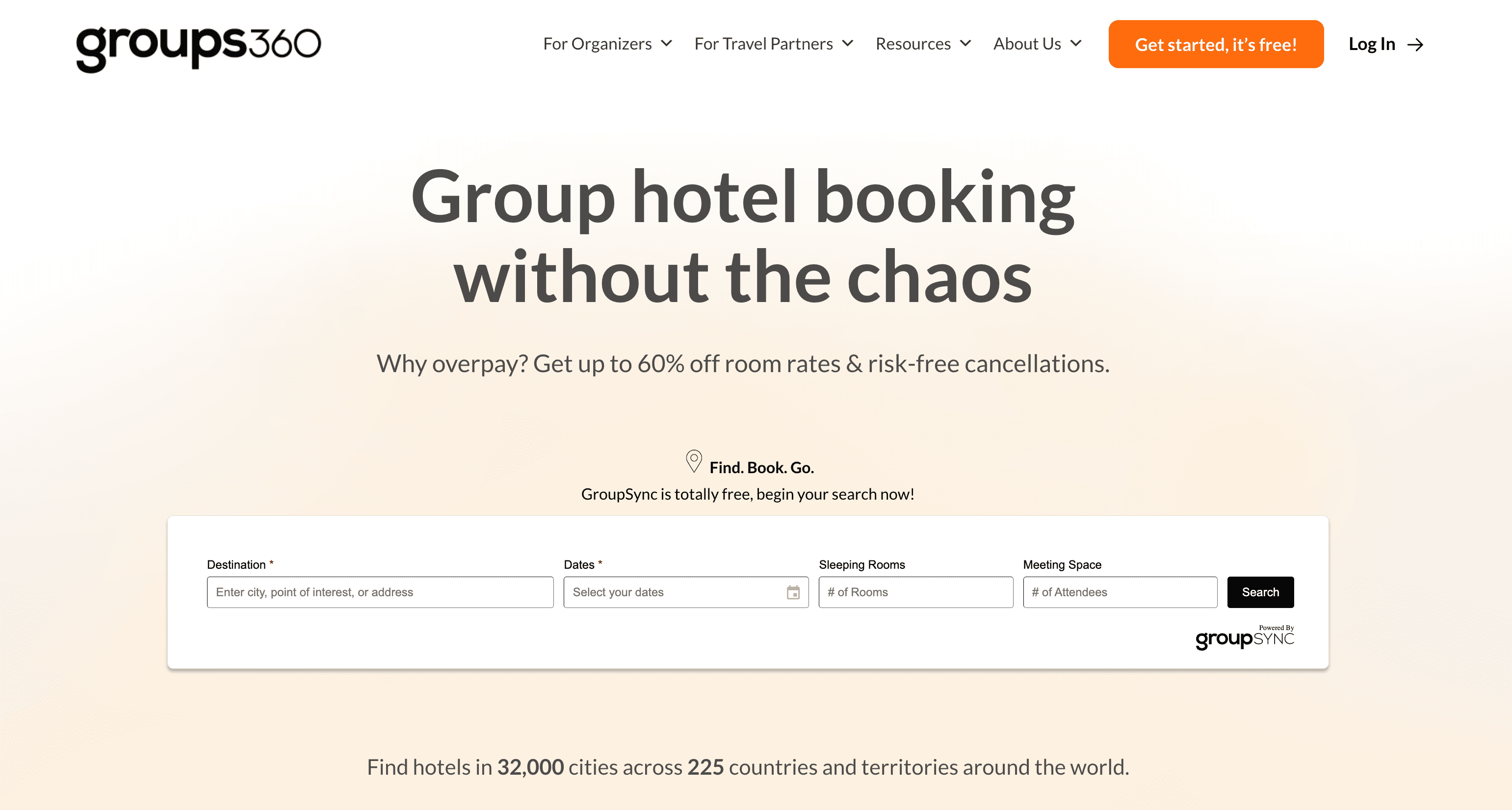
Groups360 was founded in 2014 by former Gaylord Entertainment executives and has received an $85 million investment from Accor, Hilton, IHG, and Marriott to build GroupSync, an online marketplace for sourcing and booking hotel rooms and meeting space.
The platform operates differently from the other tools in this review: rather than managing a contracted room block end to end, GroupSync functions as a sourcing and instant-booking marketplace with real-time rates, online bookings, and room availability from hotel brand reservation systems.
Best For: Corporate meeting planners and enterprise event organizers who need real-time rates and instant booking for smaller meetings (10-25 rooms, meeting space for up to 50) across Accor, Hilton, IHG, and Marriott. Organizations, hotel groups, and enterprise planners that value hotel brand integration and real-time rate transparency over a traditional room block management hotel reservation system.
GroupSync solves a specific problem that traditional room block management does not: the ability to book smaller meetings instantly, with transparent rates, and to enhance guest satisfaction by removing RFP wait time.
For corporate meeting planners managing a high volume of small meetings across those major hotel chains, the instant direct bookings capability has real value. For housing companies that drive direct bookings through contracted blocks for youth sports tournaments or associations with overflow needs, the platform operates in a different category.
Direct integration with Accor, Hilton, IHG, and Marriott hotel reservation systems and each property management system. GroupSync Connect embeds the marketplace into third-party event management platforms, with Canapii as the first integrator.
GroupSync is free to use for travel organizers and planners, with no qualification gate. The platform's full functionality, including search, RFP submission, instant booking, room block management, meeting space booking, and housing solutions, is available at no cost. GroupSync Planner+, the corporate enterprise version with approval workflows, user permissions, preferred hotel designation, and centralized reporting, is also positioned as free to start, though enterprise deployments may involve negotiated terms. Hotels pay Groups360 a commission on bookings made through the platform.
TechTrans International manages more than 1,000 events per quarter for government and corporate clients, with attendee counts ranging from 50 to 300 per event. Before adopting GroupSync, the special events planning team sourced hotels manually through phone calls and emails, sometimes taking weeks to finalize a single contract. Strict venue requirements like space size and rate caps made the search even slower.
After fully transitioning to GroupSync for hotel sourcing and contracting, TechTrans cut sourcing time by more than half. In one example, the team identified properties, narrowed options, and finalized a weeklong event contract in seven days, an outcome that previously would have taken weeks. The platform's real-time availability data also reduced the back-and-forth communication with hotel sales teams that had slowed earlier workflows.
"We're no longer calling venues multiple times just to get an answer. The time from initial request to contract has been drastically reduced." — Alissa Howell, Special Events Planner, TechTrans International
EventConnect is a Canadian-based event management platform with a housing module called Housing Connect. Based on publicly available documentation, the platform is designed as an integrated event management suite with housing as one of its core modules, which makes it a direct competitor in the full-lifecycle event housing category. EventConnect has meaningful adoption in youth sports and operates a mobile app alongside its web platform.
Best For: Best fit for youth sports tournament organizers and housing companies who need an integrated event management and housing platform from a single vendor. Organizations already using EventConnect for registration, scheduling, or team communications in daily operations will find Housing Connect a natural extension.
EventConnect's value proposition is integration breadth: housing is one module inside a broader event management platform, which reduces vendor count for organizations that want registration, scheduling, and housing from the same provider. That breadth is a real strength for organizations buying an integrated suite, and a potential mismatch for housing companies that want a best-of-breed housing platform without the rest of the event management stack.
Based on publicly available documentation, EventConnect's standalone housing deployments are less commonly referenced than its full-suite deployments, which follows a pattern similar to Cvent Passkey.
Based on publicly available documentation, EventConnect integrates primarily within its own product suite, with additional integrations to hotel reservation systems for block management.
Pricing is not publicly listed.
Capterra: 4.7 stars out of 5 - 20 ratings
Jillian S says: “We converted to EventConnect to offer to our teams a simpler more modern way to book/block hotels. The actual booking data has enabled us to capture a much greater number of room nights booked. Scheduling and registration are bonuses. As we prepared to implement the program, EventConnect had me at their offices to help with all of the details of setup. This really made a huge difference in the success of our conversion. I was not aware of all options within the software. I feel we would have gone in circle with out that time and training.”
Resiada is a meeting and event technology platform based in Etobicoke, Ontario, targeting conference planners, event organizers, and housing companies. Based on publicly available documentation, Resiada operates in the meeting and convention space with professional services wrapped around its software, and the platform has a public pricing page with a tiered structure (small, medium, large events) though specific prices are not disclosed and all tiers route to a demo.
Best For: Best fit for conference planners and event organizers who need professional services and implementation support alongside the software, especially those operating in the meetings and convention space.
Resiada's strength is in the conference and meeting space, where its reputation is well established and its professional services wrap adds meaningful support for organizations that do not have dedicated internal event technology teams. For housing companies managing high-volume sports tournaments or associations with complex stay-to-play compliance requirements, the platform's positioning is oriented toward a different use case.
Partnerships with event management companies including Streampoint Solutions.
Resiada publishes a tiered pricing page (small, medium, large events) but does not disclose specific prices.
Resiada reviews on G2 and Capterra have limited public volume. No publicly available reviews at time of writing for specific housing company use cases.
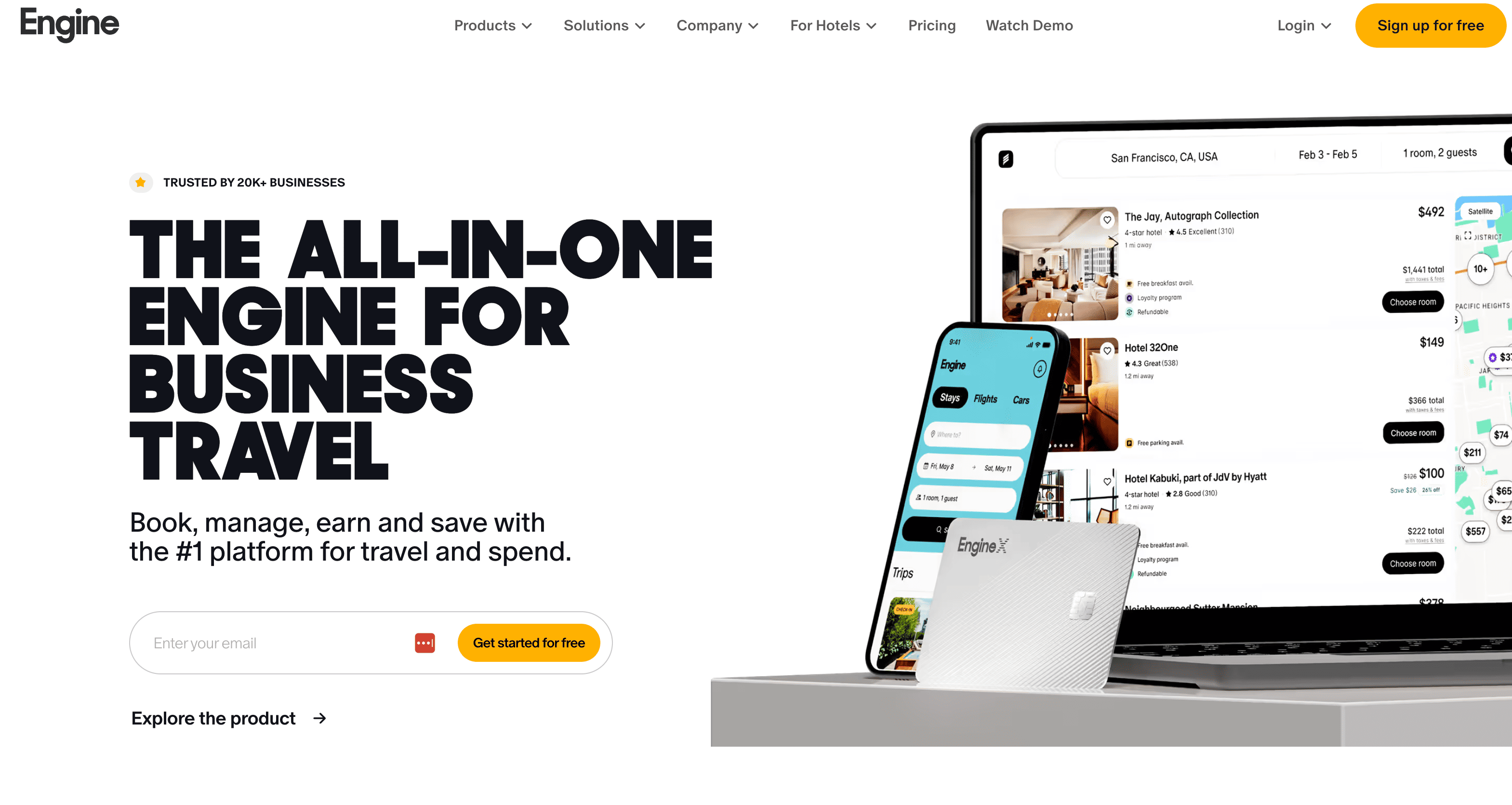
Engine (formerly Hotel Engine) is an all-in-one travel platform covering flights, hotels, rental cars, professional services, and venue sourcing. The platform is free to use with no contracts or minimums and operates on a commission-based revenue model.
Engine targets youth sports, professional sports, meetings and events, business travel, and government, with a broader scope than the housing-focused platforms in this review. The platform's reservation system covers hotel bookings alongside other travel categories, and recent customer announcements include Premier Lacrosse and AJGA.
Best For: Best fit for organizations who need a broader travel management platform covering flights, hotels, cars, and professional services in one place, rather than a housing-specific lifecycle platform. Useful for youth sports and professional sports organizations who need consolidated travel management across multiple trip types.
Engine's all in one solution positioning is a legitimate differentiator for organizations that want flights, hotels, cars, and professional services online bookings from one vendor. For event housing specifically, the platform includes the core building blocks (room blocks, sub-blocks, reconciliation, invoicing, white-label), but the depth of each workflow is evaluated here against platforms purpose-built for the housing lifecycle. Engine's broader scope is a strength in its intended use case and a trade-off against more specialized housing tools.
Based on publicly available documentation, Engine operates as a vertically integrated travel platform.
Free to use with no contracts or minimums. Commission-based revenue model.
G2: 4.4 stars out of 5 - 23 ratings
Alex L. says: “Engine has completely changed how we manage business travel and how much we save on it. Huge cost savings without sacrificing quality of hotels available. It's like one of the last minute hotel sites, but without having to be last minute…”
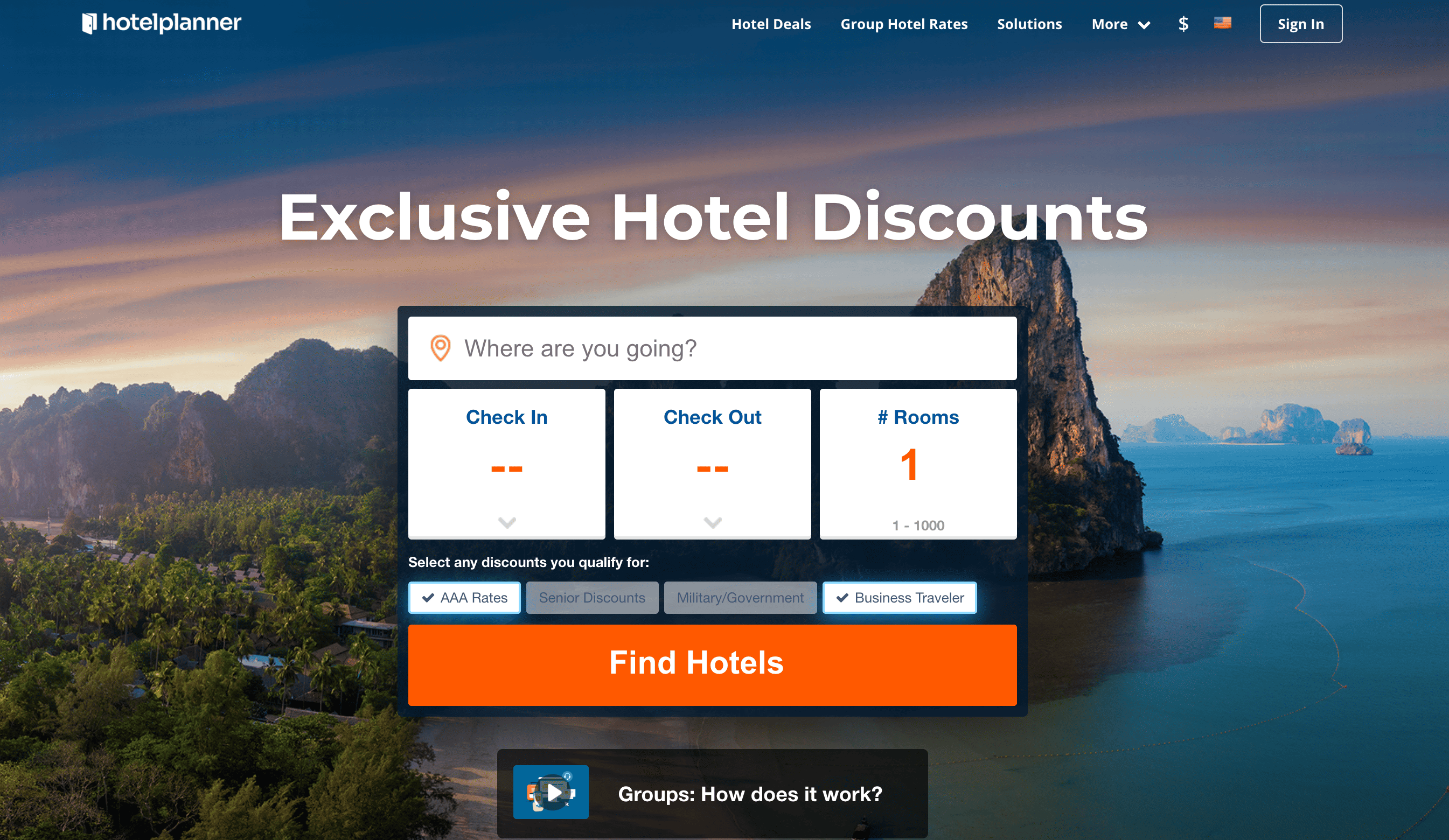
HotelPlanner is a long-established player in the hotel group space, functioning as a consumer-facing and planner-facing platform that handles conferences, meetings, and groups across hotel chains and independent hotels for all event types. The company has an RFP tool and operates a broader travel business alongside its group hotel booking capability. HotelPlanner's model is closer to an online travel agency for groups than a traditional room block management platform.
Best For: Best fit for event organizers and meeting planners who need broad hotel coverage across many event types and a consumer-friendly booking interface. A useful alternative when specialized housing lifecycle workflows are not the priority.
HotelPlanner's breadth is its strength and its trade-off. The platform handles many event types, which gives event organizers a single place to source hotels across a wide variety of situations. The depth of the housing lifecycle workflow (contracting, reconciliation, invoicing, compliance tracking, and the smooth hotel operations coordination housing companies rely on for direct bookings at scale) is not a primary positioning area based on publicly available documentation, which places HotelPlanner closer to a group travel marketplace than a housing company operating system.
Based on publicly available documentation, HotelPlanner operates as a self-contained platform with hotel partner integrations rather than deep integrations with external CRM, registration, or compliance systems. Pricing
HotelPlanner operates on a commission-based model. Specific pricing varies by booking type and volume.
One user from HotelPlanner testimonial says: “You have a client for life. We will definitely use you next year for our annual 46th reunion in 2010. We don't know where the destination will be as of this writing, but we know who will be our planner! Thank you so much again for your excellent and professional service. I would be happy to fill out any type of evaluation or recommendation of your service. Just let me know.”
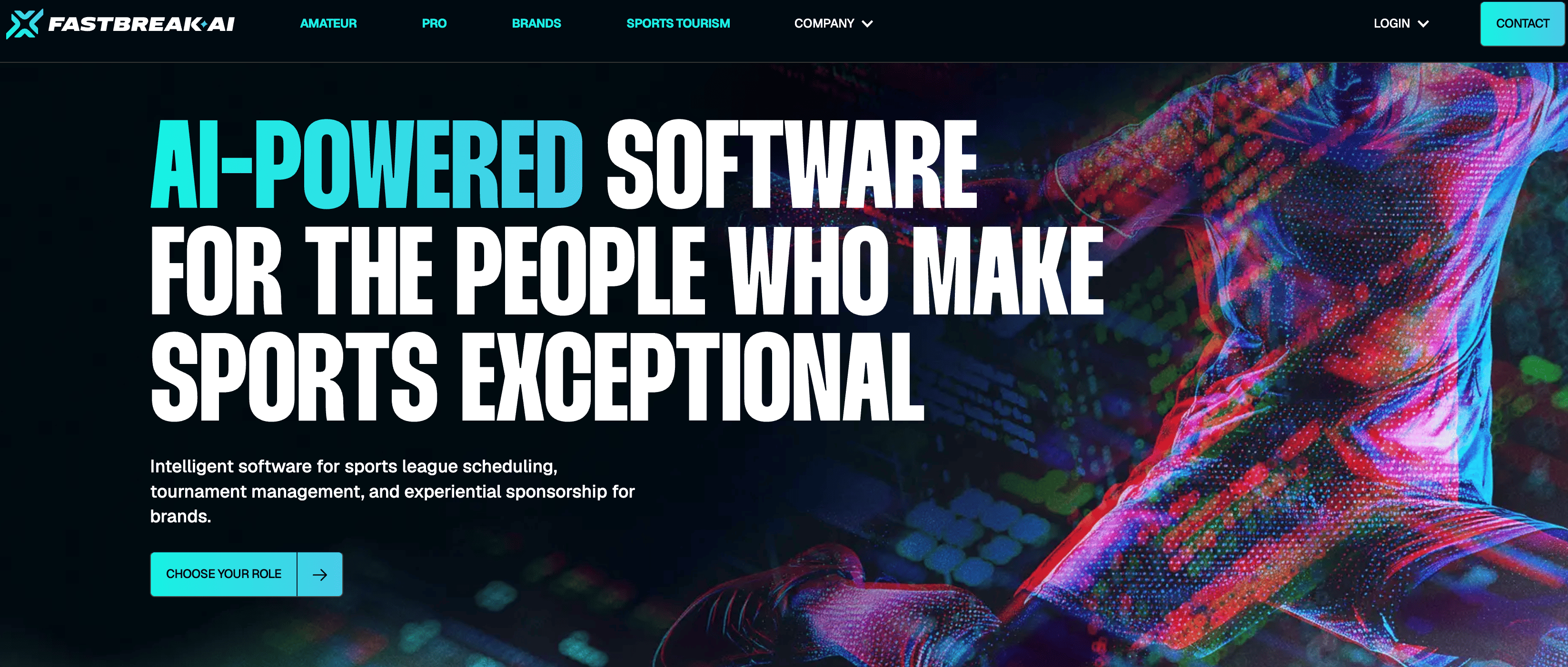
Fastbreak AI is a sports operations platform built for AI-powered scheduling and tournament management for professional leagues, amateur leagues, and youth sports. Customer references include the NBA, MLS, NHL, WNBA, NWSL, La Liga, Serie A, and the SEC, among others.
The platform's housing capability is delivered through Fastbreak Travel, which brings hotel sourcing, contracting, and tournament travel logistics into the Fastbreak ecosystem alongside its scheduling and tournament management tools.
Best For: Best fit for tournament organizers and sports operators who want event housing tied to scheduling, registration, and tournament management within a single AI-powered operations platform. Most appropriate for organizations already using or evaluating Fastbreak's scheduling or tournament management capabilities.
Fastbreak's identity is sports operations and AI-driven scheduling, not event housing in the traditional sense. Fastbreak Travel adds hotel sourcing and contracting capability, but how it compares to purpose-built housing platforms across the full lifecycle, covering RFP automation, contracted block reconciliation, automated invoicing, and stay-to-play compliance, is not prominently detailed in available documentation.
For tournament organizers already using or evaluating Fastbreak's scheduling or tournament management capabilities, the housing addition is a natural extension. For housing companies whose primary need is full lifecycle housing depth, a purpose-built housing platform is a more direct match.
Native integration across Fastbreak's product modules including Pro Schedule, Perform, Compete, Connect, Pulse, Travel, and Ticketing. Standard sports technology integrations across leagues and tournament operators.
Pricing is not publicly listed for Fastbreak Travel. Fastbreak operates an enterprise sales motion across its sports operations platform.
Fastbreak AI customer references for scheduling and tournament management are extensive, including major professional leagues. Customer case studies specific to the Fastbreak Travel housing capability are limited at time of writing.
.png)
Lucid Travel operates in the youth sports housing space with a model similar to online travel agencies, focused on live hotel inventory booking rather than contracted room block management. The platform has adoption in youth sports including PONY Baseball and Babe Ruth League, and has worked with ESPN Events and the Professional Bowlers Association. Lucid Travel's model is closer to consumer travel booking adapted for youth sports than a housing company operating system.
Best For: Best fit for youth sports events who need to offer a live inventory hotel booking link to attendees without contracting and managing a full room block. Useful for event organizers who value simplicity over housing lifecycle depth.
Lucid Travel's positioning is closer to a live inventory booking tool than a full housing lifecycle platform. For youth sports events that want to drive direct bookings without the complexity of contracting and managing a room block, that simplicity is the value proposition. For housing companies that need contracting, reconciliation, and compliance workflows, the platform operates in a different category.
Based on publicly available documentation, Lucid Travel operates as a self-contained platform.
Commission-based pricing.
Testimonial from Justin Waters: “Lucid Travel has been such a great resource for our students and us as administrators. The simplicity of the platform is so user-friendly and the Lucid travel staff are always available to help with any questions or needs that we might have. We have really valued our partnership and they have turned innovative ideas into reality to expedite processes to maximize the efficiency for all users, in return saving our students and University a lot of time, money and resources.”
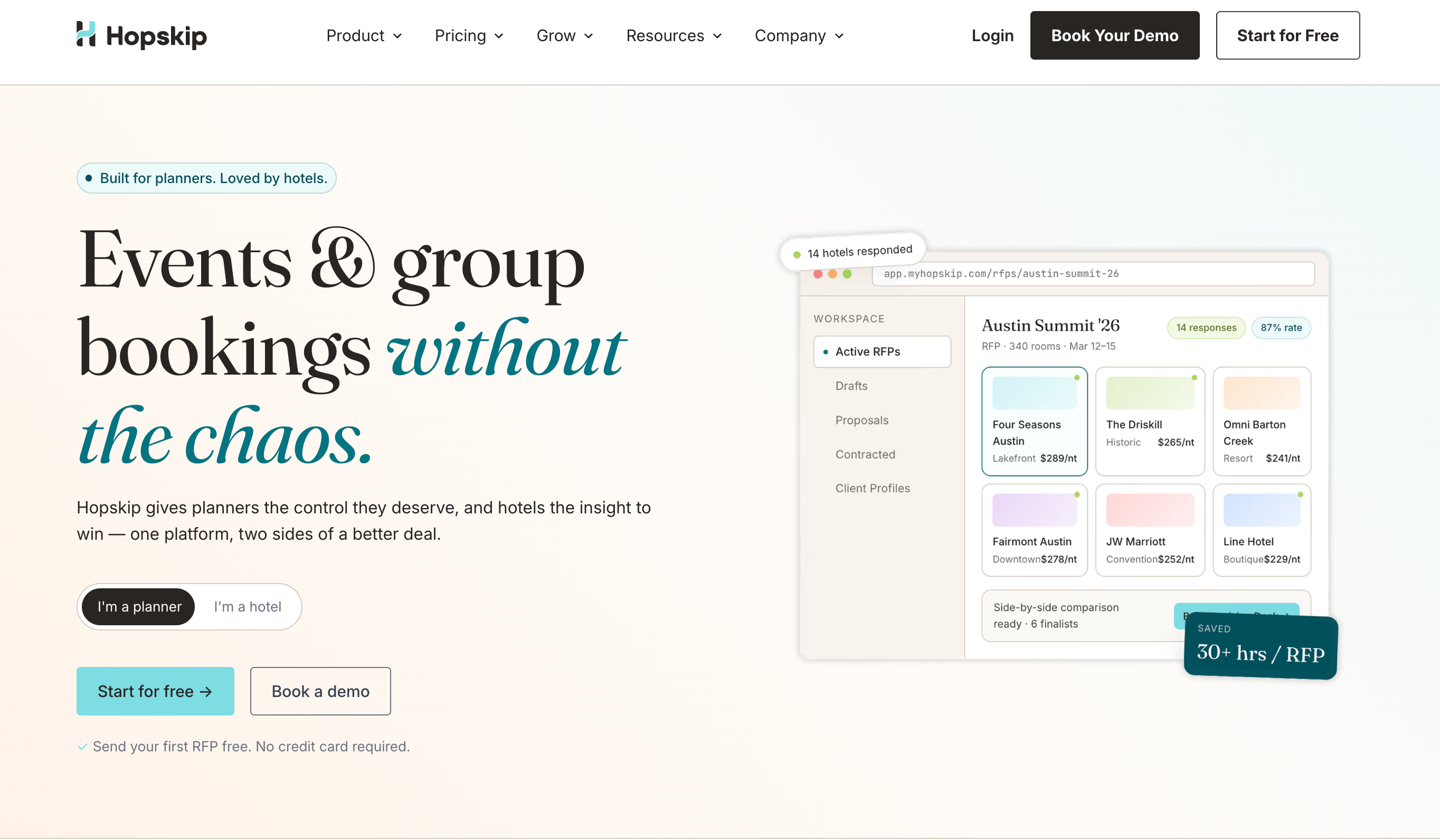
HopSkip is a meeting planner-focused platform that concentrates specifically on the hotel RFP workflow for corporate meetings, events, and conferences. Based on publicly available documentation, the platform is purpose-built for the sourcing and RFP stage rather than the full lifecycle of contracting, block management, reconciliation, and invoicing.
Best For: Best fit for corporate meeting planners and conference organizers whose primary workflow is sending hotel RFPs and managing responses, rather than full lifecycle housing operations.
HopSkip's focus on the RFP workflow specifically means it handles that stage at reasonable depth for meeting planners. For organizations that need the full lifecycle (contracting through invoicing), the platform would typically be used alongside other tools rather than as the system of record.
Based on publicly available documentation, HopSkip focuses on the RFP workflow with integrations calibrated to that stage. Pricing
Pricing is not publicly listed.
Katie Riggs leads sourcing at Riggs & Co., an event strategy and execution company. Before adopting HopSkip, her team's RFP process relied on email chains, spreadsheets, and follow-up cycles with hotel partners over missing details, which made proposal comparisons time-consuming to assemble for client presentations.
According to the published case study, the team reduced approximately 200 hours of annual manual work tied to proposal comparison and presentation building, and Riggs reports client savings of more than $100,000 per event from concessions captured earlier in the RFP process. Pre-built concession templates and required RFP fields are cited as the features driving the change.
Software for booking and managing hotels means different things to different buyers.
An independent hotel or boutique hotel looking at a property management system is shopping for something completely different than a housing company managing a 50-hotel tournament block. A boutique hotel sets up hotel management software to run its front desk. Large hotel brands and hotel groups evaluate a channel manager to sync rates across multiple booking platforms. Independent hotels lean on property management software for daily operations.
Those tools manage hotel operations on the property side of the workflow. Their job is to manage hotel operations inside a single hotel, not coordinate across many.
That is not what a youth sports housing company needs. A housing company needs a hotel reservation system that coordinates block inventory across dozens of properties that each already run their own property management system.
A corporate meeting planner looking at booking software for internal travel is solving a different problem than a youth sports housing company looking at a hotel reservation system for a stay-to-play tournament. All of these searches return "hotel reservation software" in Google, which is why the category is so noisy.
Before comparing any specific platforms, it helps to understand what the category actually covers and where each tool fits.
According to the Sports ETA State of the Industry report, released in April 2026, sports tourism generated 124.3 million hotel room nights and $111.2 billion in direct economic impact in 2025, with participatory sports tourism (primarily youth and amateur events) accounting for $60.1 billion of that direct spending and 227.6 million travelers. That volume is why the category is crowded, why group travel needs purpose-built workflows, and why picking the wrong tool has real financial consequences.
The ten tools in this review operate in one or more of five functional domains. Each domain handles reservations, group travel bookings, and online reservations in its own way, and the tooling that serves one domain rarely serves another without compromise.
None of these tools replace a property management system or a channel manager at the property level. A channel manager inside the property management system syncs live room availability across booking channels. A property management system anchors front desk operations and desk management inside the hotel. The hotel reservation software in this review sits one layer above, managing the reservations that flow into those property management systems and feeding room bookings back through each channel manager.
These carry an event from hotel identification through RFP, contracting, branded booking site delivery, rooming list transfer, pickup reconciliation, and final invoicing. They are the system of record for housing companies and event organizers managing contracted room blocks and hotel bookings at scale. This is where EventPipe, EventConnect, Playbook365 (Staybook), and Meetingmax operate.
Built for large-scale association and corporate events where the housing module plugs into a broader event management platform. These tools support guest experience at scale and tight integration with registration systems. Cvent Passkey is the standard here.
Connect directly to real-time hotel inventory without requiring a contracted block. Useful for events that have overflowed their original block or never contracted one. These tools handle reservation management through a live booking engine rather than a traditional block. EventPipe Presto, Meetingmax's ARES partnership, and Groups360 handle variations of this.
Combine hotel booking with flights, rental cars, and other travel services. Engine is the primary example in this review. These tools solve a different problem than block management and are evaluated here because buyers in adjacent searches encounter them.
Focus specifically on sourcing and sending RFPs to hotels, without the full lifecycle of contracting and reconciliation. HopSkip sits here.
The evaluation framework is weighted toward a hotel reservation system built for the full event housing lifecycle, from hotel website branding to final invoicing, because that is the workflow most housing companies and event organizers need to support. Tools designed for other domains will score lower by design, and those scores should not be read as quality judgments on the tools themselves. A low score usually means the tool is built for a different job, not that it does its job poorly.
Event housing volume keeps climbing. Youth sports participation has been on a post-pandemic rebound, with 55.4% of youth ages 6 to 17 playing organized sports in 2023 according to the Aspen Institute's State of Play 2025 report. Association conventions are returning to pre-pandemic attendance. Citywide events are back to contracting hundreds of hotels at once.
More volume means more hotel reservations, more group bookings, more rooming list complexity, and more ways for commission revenue to leak if the reservation management workflow has gaps.
The hospitality industry has been investing heavily in this space, and the best platform in 2026 looks different than it did five years ago.
Live hotel inventory, dynamic pricing visibility, automated compliance tracking, integrated payments, and real-time business intelligence used to be premium features reserved for enterprise customers. They are now the baseline that housing companies expect when evaluating a reservation system that supports the booking process end to end.
Event-focused hotel software sits in its own category, distinct from the hotel management tools that run operations at individual properties.
Hotel management software supports front desk operations, revenue management, dynamic pricing, channel management, and daily operations inside a single property. That work sits on the property side of the workflow, not the housing side. The two categories can coexist in a technology stack, but they solve different problems, and the best tool for one is rarely the best tool for the other.
A channel manager inside a property management system handles distribution. It pushes that single property's room availability to online travel agencies, the property's website, and direct channels, while the front desk team handles check-in and guest services.
A hotel reservation platform built for events sits one layer above. It aggregates room availability across a contracted block of hotels, each of which already runs its own property management system and channel manager. The event-side platform does not replace any of that. Both layers have to work together, with each property's channel manager handling its own inventory distribution and the event platform managing the block across all of them.
Hotel software for vacation rentals serves a different buyer entirely. Each category solves its own problem, and buyers searching for the best hotel management software, the best hotel reservation tool, or a vacation rentals platform are usually shopping for different products even when the search terms overlap.
Hotel management software and channel managers are the native tools of the property. Hotel reservation software, as this review uses the term, is the tool of the housing company managing blocks across many properties.
Picking the best hotel reservation platform depends entirely on the job it needs to do. Picking the best hotel reservation platform depends on the job it needs to do. A platform built for the full event housing lifecycle handles a different problem than one built for instant booking, and the right tool for a 200-person conference is not always the right tool for a 20,000-attendee citywide event.
The best hotel management software for an individual property, which handles its own hotel operations, revenue management, guest profiles, revenue management decisions, and channel manager syncing, lives in a different category entirely. Below are the feature categories that separate a platform capable of supporting serious event housing operations from one that checks a reporting box.
Every other feature in this list depends on this one.
A reservation system that handles the full event housing lifecycle in a single system of record processes data once and uses it everywhere. A platform that handles one or two stages and leaves the rest to spreadsheets processes the same data multiple times. Every manual re-entry is a chance for something to go wrong.
That is the difference between hotel reservation software that scales with an operation and booking software that forces an operation to grow around its limitations. The gap shows up most at reconciliation, where booking software without full reconciliation quietly leaves revenue on the table.
The difference is not cosmetic. A rooming list that matches the booking site, which matches the pickup report, which matches the invoice, only happens when all four live on the same data.
Once those workflows split across separate systems, the seams between them become where commission revenue disappears. A guest who books through one system, modifies through another, and reconciles through a third is a guest whose data gets re-typed at every handoff. Every handoff is a chance for an error that surfaces weeks later as a missing commission line on an invoice.
When evaluating the best hotel reservation software for an event operation, this integrated lifecycle test is the first filter that matters.
See the full event housing lifecycle in one platform. Request a demo
The best hotel reservation software for any organization depends on event type, housing company maturity, and the specific problem the platform is expected to solve. Below is a practical framework mapped to the most common scenarios.
Primary recommendation: EventPipe. Purpose-built for this scenario. Room Block Management covers the full lifecycle, Teams Management handles stay-to-play compliance and blockflation, and Presto addresses post-block overflow.
Participatory sports tourism (primarily youth and amateur events) drove $60.1 billion in direct spending and 227.6 million travelers in 2025, according to Sports ETA's State of the Industry report. Choosing a reservation system that tracks team-level bookings and prevents out-of-block leakage is the difference between capturing that revenue and watching it walk to unapproved hotels.
Primary recommendation: EventPipe. Presto's post-block capability addresses this directly, letting associations keep capturing reservations and commission revenue through the event's hotel website after the contracted block sells out.
Reasonable alternative: Meetingmax with ARES. Solves the same problem, with the trade-off that post-block delivery depends on the ARES partnership rather than a native platform capability.
Primary recommendation: Cvent Passkey. The standard for this scenario, especially for organizations already using Cvent Event Management. Sub-block management and the integrated registration-to-housing workflow are built for the scale of enterprise conferences.
Reasonable alternative: EventPipe. Fits organizations that want a standalone housing-focused platform without committing to the broader Cvent ecosystem.
Primary recommendation: Groups360 (GroupSync). Real-time rates and instant booking for 10 to 25 rooms across Accor, Hilton, IHG, and Marriott. The model is built around a live booking engine, which fits organizations that need fast reservations in a few clicks without a full RFP.
Reasonable alternative: HopSkip. Better fit for organizations whose primary workflow is RFP sourcing rather than instant booking.
Primary recommendation: EventPipe. The platform's scope across youth sports, meetings, and associations, plus its Sports ETA partnership, fits this use case. The goal for these operators is capturing in-block reservations across a portfolio rather than ceding volume to third-party channels, and a single reservation system that supports every event type makes that easier to manage.
Reasonable alternative: Meetingmax. Established presence in this segment with depth across the core block management workflow.
Primary recommendation: Engine. Operates in this broader travel category and supports a reservation calendar across multiple trip types in a single interface.
Organizations primarily focused on event housing would typically use Engine alongside a purpose-built housing platform rather than as a replacement.
The best event housing stacks layer multiple tools, and that is by design. Most of the platforms reviewed here are not substitutes for each other. They are complements that serve different parts of the workflow. A hotel reservation system covers the core housing lifecycle. A registration platform handles event entry. An accounting system handles financial reporting. Each plays its role, and the value of the stack comes from the integration capabilities that connect existing systems across the operation.
The most common stack for a housing company or event organizer looks like this: a full event housing lifecycle platform (like EventPipe) as the system of record for contracted blocks, RFPs, booking engine delivery, reconciliation, and invoicing. This sits alongside, not in place of, the property managers and hotel-side systems that run each property's daily operations.
A registration platform (SportsEngine, LeagueApps, TeamSnap, StackTourney) for event entry and team management. An accounting system for financial reporting. A CRM for hotel and client relationships. A payment processor for online payments at the online booking engine layer, which helps streamline operations between the booking flow and the housing company's accounting system. The housing platform integrates with the rest of the stack rather than replacing any of them.
This is an important distinction. Adopting EventPipe does not mean ripping out SportsEngine. It means making the housing layer do what it does best, while the registration platform keeps doing what it does best, and the two systems share data through integration. The same applies to accounting, payment processing, and CRM.
Organizations that try to consolidate everything into a single all in one solution often discover that depth in one area comes at the cost of depth in another. The best hotel reservation software for an event operation is usually the one that covers the event housing lifecycle with real depth, helps teams manage reservations cleanly from booking through invoice, and integrates with the other tools in the stack.
The best hotel reservation software for any event operation is the one that solves the specific problem that operation faces, whether that is a purpose-built housing lifecycle platform, a hotel management companion, or an all in one solution for broader travel. For housing companies managing multi-event portfolios with stay-to-play compliance and post-block overflow, EventPipe's full event housing lifecycle platform is built for exactly that job.
For large enterprise conferences already embedded in the Cvent ecosystem, Passkey is the established standard. For corporate meeting planners booking smaller meetings across major hotel brands, Groups360's instant booking model is purpose-built for that use case. For housing companies who need a housing-only platform with post-block overflow through the ARES partnership, Meetingmax is a strong alternative.
The goal of this review has not been to declare a single winner for every room bookings scenario. It has been to help housing companies, associations, event organizers, and meeting planners match the right tool to the right problem. A score in the 50s is not a quality judgment; it reflects a tool that is built for a different job than the one this framework evaluates. A score above 85 reflects alignment with a specific framework, not superiority across every possible event housing scenario.
Readers are encouraged to verify current capabilities, pricing, guest services, and features directly with each vendor before making a purchasing decision. Feature sets evolve, and a demo with real event data is the most reliable way to evaluate fit.
Ready to see what EventPipe looks like in your environment? Request a demo.
A reservation platform and a hotel booking engine solve different parts of the process. This broader category includes room block management, RFP workflows, contracting, pickup reconciliation, hotel management for event portfolios, and invoicing. A booking engine is specifically the consumer-facing widget or portal that attendees use in the booking process to make online bookings. In event housing, a direct booking engine is one component of the larger platform. Most event platforms include a built-in booking engine as part of the hotel reservation system rather than relying on a separate direct booking engine widget. The booking engine handles the transaction and the online booking experience for the guest, which is where direct bookings get captured. The full reservation system is where teams manage reservations across every stage: contracting, inventory, rooming list, pickup, reconciliation, and invoicing.
Housing companies manage reservations, guest data, guest details, online bookings, and online payments through PCI-compliant infrastructure that encrypts credit card information at every step of the reservation process. Enterprise-grade event housing platforms typically carry security certifications including SSAE 16, ISO 27001, and PCI DSS compliance, with AES-256 encryption at rest and TLS/HTTPS in transit. Guest data is not stored in plaintext, and multi-region deployments support disaster recovery and enhance guest satisfaction by keeping the booking flow online. Guest profiles and guest preferences stay encrypted, and access to guest profiles is restricted by role. Before selecting a hotel reservation software vendor, event organizers should verify the specific certifications the platform carries, its handling of guest preferences,, confirm how payment data flows between the booking engine, the housing company, and the hotel's own property management system, and review how the vendor handles guest communication around sensitive data.
Event housing platforms manage cancellations, refunds, and revised booking confirmations through configurable policy settings defined during event setup. This is how housing companies manage reservations once an event is live and guests start modifying plans, and platforms handle the hotel reservation lifecycle differently. Platforms typically allow housing companies to set cancellation windows, deposit forfeiture rules, and refund eligibility for specific reservation types. When a guest cancels inside the policy window, the reservation system tracks the cancellation in the pickup report and adjusts the reservation record. The refund itself is processed through the payment processor connected to the platform, and online payments already captured are either refunded or held per policy. Event organizers should confirm whether a platform supports deposit-based models, upfront fees at reservation, guest-initiated cancellations versus organizer-initiated cancellations, and handling of guest preferences during cancellation, since those handling requirements vary significantly across event types and reservation management workflows.
When switching platforms, an organization should plan for historical data migration and guest experience continuity before signing the new contract. The typical process covers three data sets in the existing systems: past event records (RFPs, contracts, rooming lists), guest reservation history (for repeat attendees), and hotel partner relationship data (pickup history, commission rates, preferred partners). A vendor switch is the right moment to audit data quality, since historical errors get carried forward if they are not caught during migration. Most platforms support CSV-based import for structured data. Organizations should also confirm data export terms with the outgoing vendor before signing anything with a new platform, and keep at least two years of historical pickup and commission data for audit and tax purposes. Ready to see what EventPipe looks like in your environment? Request a demo

Jeff is the Marketing Manager at EventPipe. He brings a decade of Marketing experience with a background in social media, events, SEO, and content. Outside of work, Jeff is an independent Hip Hop artist who regularly releases and performs his music and loves to golf and play ice hockey in his spare time. Jeff holds a bachelor of arts in Economics from Union College, with a minor in Spanish.
