
Every year, millions of hotel room nights get booked for events: youth sports tournaments, association conventions, corporate summits, trade shows, etc. Behind those bookings is a discipline most people never see: sourcing the right hotels, negotiating the contracts, running the booking sites, and reconciling what actually happened against what was promised. The people doing this work are housing companies, event organizers, and tournament operators, and the stakes are higher than one might realize.
Housing management for associations carries the added weight of funding the next event, since commissions and rebates often offset registration costs.
A single regional tournament or mid-size convention can generate tens of thousands of dollars in hotel commissions and rebates. Every step of the process, from the first hotel contact to the final invoice, either protects that revenue or lets it leak.
Event housing management is a revenue operation dressed up as a lodging workflow, and the groups who run it well treat it that way.
This post breaks down what event housing management is, how it works across multiple hotels, and where most operations lose money.
Event housing management is the process of sourcing, contracting, booking, and reconciling hotel rooms for event attendees. It covers the full lodging experience for attendees, exhibitors, and staff, from first hotel outreach through post-event reporting, reconciliation, and invoicing.
Event housing provides a centralized booking system that connects attendees to trusted hotels near the venue. The goal is to place enough rooms at the right hotels at the right room rates, then capture the commissions and rebates those hotel reservations generate for housing companies and their customers.
Event housing management is broader than managing room blocks alone. The full discipline covers every aspect of the work, including hotel sourcing, RFP creation, contract negotiation, room block negotiation, reservations handling, inventory management, customer service for attendees, exhibitors, and other groups, and final invoicing.
Every aspect affects final commissions and attendee satisfaction. Effective event housing requires balancing attendee comfort with logistical efficiency and financial risk while coordinating reservations, services, and accommodations for all audiences involved.
Hotels pay commissions and rebates to whoever delivers room nights for large events. A hotel might pay a 10% commission on room revenue plus a per-night rebate. Across multiple hotels, hundreds of hotel rooms, and a four-night event, the numbers add up fast.
That revenue funds housing companies, pays for attendee services, and subsidizes the cost of hosting the next event.
Every reservation that’s booked outside of the official block is lost commission. Every reservation that converts to a hotel stay without being credited to the event is a missed rebate. Event housing management is not operational overhead. It is the hidden engine that keeps the next event financially viable.
“In-house teams often approach housing as a straightforward room booking task. Experienced planners build a strategy aligned to event goals like room night targets, stay patterns, and peak demand periods. They actively manage distribution across hotels, lock in discounted rates months in advance, gather data on economic impact, and when applicable, track team pickup and athlete bookings to support Stay to Play or housing requirements for events.”
- Samantha Barnes, Customer Success Manager at EventPipe

The event housing management process has eight phases. Each is a revenue checkpoint that connects the housing manager to attendees and hotel partners. For a deeper breakdown, see the five key components of event housing management.
Housing teams identify candidate hotels near the event venue based on location, quality, room types, budget, and capacity. Room types matter early because not every property has the right mix. Selecting hotels within reasonable walking or driving distance minimizes transit issues and gives attendees more time to rest or network.
Rooms are typically selected for their closeness to the event venue, facilitating networking. Mixing room types across properties lets large events accommodate every audience segment.
Associations still weighing locations can use this guide to choosing a conference venue and hotels for an association event to score venues on walkable guest rooms before anything is signed.
For youth sports tournaments running on Stay to Play policies, hotel identification has an extra layer. Approved hotels are typically located within a designated radius of the venue, often 50 to 90 miles, to ensure convenience for teams while maximizing the event's impact on the local economy.
Housing teams have to be deliberate about which hotels make the approved list, since teams, athletes, and families are required to book only through those official properties. That includes ruling out off-list hotels, relatives' homes, and alternative lodging like RVs unless exceptions are approved.
A request for proposal goes out to hotel partners with details on room rates, availability, amenities, and concessions. Each request should note specific needs like accessible rooms, suite inventory, parking, or on-site services.
High-quality Wi-Fi is often a top priority for event attendees, along with other amenities such as breakfast services and networking spaces. Higher request response rates give event planners and housing managers more hotel partners to negotiate with.
Event planners finalize rates, commission structure, rebates, attrition clauses, cutoff windows, complimentary rooms, and other details. Effective contract negotiation can lead to significant cost savings and improved terms for event planners, which can create a better experience for attendees.
Meeting space belongs in that same negotiation, since what the meeting space will actually cost rarely shows up in a first quote.
Event planners can use their negotiating power to secure discounts or preferential rates based on the volume of bookings, a major draw for attendees and a clear path to event success.
Contracted inventory is loaded across multiple hotels and room types. Access to a contracted room block ensures a room is available at specific, secured rates even when hotels seem fully booked to the general public.
Managing inventory across different properties requires tight coordination and a clean process. Sub blocks can be created for specific groups of attendees, specific teams, or VIPs with specific needs.
A branded, mobile-friendly booking site goes live so attendees can compare booking options and book their rooms. Attendees typically use a specialized website or housing portal to book rooms, which prevents the need to call hotels directly.
The branded booking portal acts as a one-stop shop for all accommodations. A quality booking process drives higher attendee engagement, stronger satisfaction levels, and better in-block pickup.
Attendees have questions. Reservations get changed. Rooms get added. Housing managers handle inbound support across phone, email, and self-service tools to keep attendee satisfaction levels high throughout the booking window.
Maintaining continuous communication with hotel partners and providing regular updates to attendees about their accommodation status helps anticipate and address issues before they escalate. Providing timely and clear information about hotel amenities, policies, and nearby attractions significantly improves the attendee experience.
The cut-off date is the final day to book a room at the discounted group rate, after which unreserved rooms are released back to the general public. Around two weeks before the event, the final rooming list goes to each hotel to load guest reservations into the hotel system.
Actual stays are matched against contracted room blocks. Keeping track of pick-up rates and average length of stay produces net room nights, which drive the final commission invoice. Keeping track of the average length of stay also reveals which attendees extended their reservations beyond the event window.

Event housing is managed by youth sports housing companies, event organizers handling accommodations in-house, or a mix of the two. The split depends on event size, frequency, budget, and how much revenue the operation wants to retain.
Associations deciding between an AMS module, an outside housing company, and dedicated software can compare all three in this association event housing management software guide.
Most event housing management operations hit the same recurring problems, each one with its own details.
A term EventPipe coined in the Stay to Play compliance world, for when teams or attendees over-reserve hotel rooms inside contracted room blocks, booking more rooms per person than they need to lock in inventory. Inventory looks full. Actual pickup falls short. Commission revenue shrinks at reconciliation.
PCMA and Kalibri Labs research on convention room blocks found that only about 48 percent of convention attendees book through the official event housing system, even when the majority of the attendee audience actually stays inside contracted hotels.
For organizers paid on in-block bookings, that leads to a direct hit to revenue. In youth sports, the parallel problem is teams booking lodging outside designated hotels, which is why Stay to Play policies exist and why compliance tracking matters.
Sending an RFP request to 50 hotel partners by hand can take most of a workday. Doing that across dozens of events per year caps how fast a small housing operation can accommodate new growth.
Moving data between booking services, hotel PMS tools, and accounting software by hand creates mistakes, missed commissions, and incorrect invoices. Every process error is either unbilled revenue or a strained hotel relationship, and the lack of clear details on what went wrong leads to more mistakes.
Directors and owners often cannot see how pacing on a specific event compares to the previous year. Managers tracking performance across a portfolio need reporting that most spreadsheets cannot deliver.
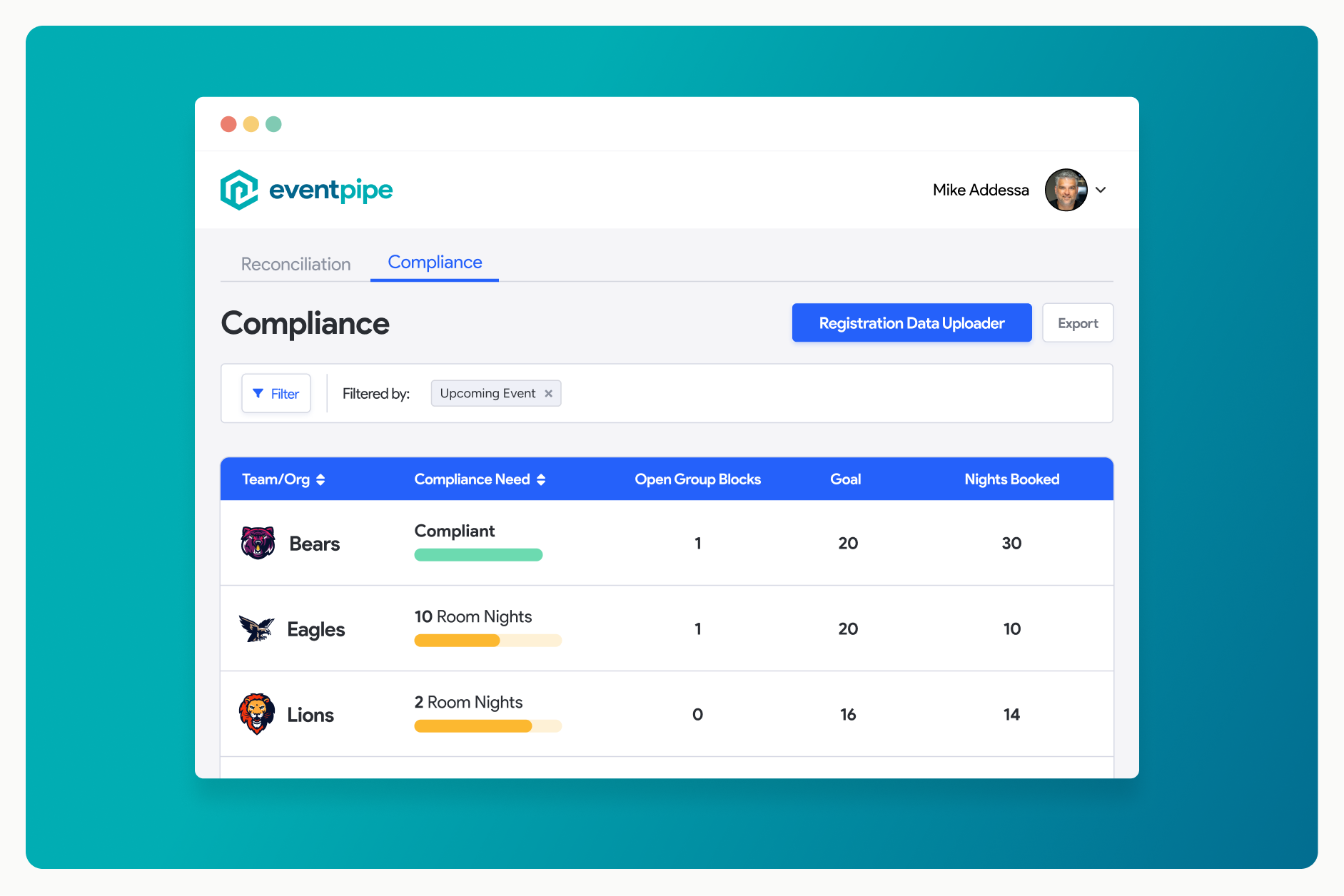
“The most expensive reconciliation mistake is failing to capture and validate actual consumed room nights before final billing and commissions. In youth sports, relying on initial block reports, estimated pickup, or incomplete hotel data causes revenue to slip through the cracks. Instead, reconciliation should be based on final folios, actualized rooming lists, and adjustments for no-shows, early departures, walk-ins, and out-of-block bookings.”
Samantha Barnes, Customer Success Manager at EventPipe
Purpose-built event housing management software handles the full process in one platform: request distribution, contract management, inventory across multiple hotels and sub blocks, a branded booking site for all your attendees, real-time tracking to monitor pick up rates, rooming list generation, reconciliation, invoicing, and attendee support services.
How much of that list a vendor actually covers is where the options separate, which is what our review of event booking software measures.
Good event management software doesn’t just digitize tasks. It helps youth sports housing companies and event organizers create cleaner workflows, eliminate manual re-entry, recover missed commissions, and close the reporting gaps that hide revenue leaks. Real-time visibility into booking details makes for better decisions, faster.
The strongest event housing management platform ties those same functions to a single login, so a housing company can move from hotel identification straight through reconciliation without re-entering data at each stage.
Housing companies that tighten their operations around dedicated software tend to grow faster. Stack Sports' TeamINN division grew 80% after moving to EventPipe's hotel booking platform built for event housing.
See how EventPipe handles the full event housing process. Request a demo.
Event housing management might only appear to be a logistics job from the outside. From the inside, it is a revenue operation with dozens of places where money leaks.
The operations that treat every aspect as strategic, with the right event planners, the right process, the right services, and the right event management software, create stronger outcomes and keep more of what they earn.
Talk to someone who knows event housing. Request a demo with EventPipe.
The integrations that matter most connect housing data to the tools around it. Payment processing handles hotel reservations flowing through the booking site. CRM integration keeps attendee and contact data in sync. Accounting integration removes manual work from invoicing and commission tracking. Analytics integrations feed pick-up rates, pacing, and reconciliation details into business intelligence tools. For youth sports, conferences, and associations, registration platform integration matters so that accommodations and attendee data stay connected to event signup.
Yes, but only at a small scale. A single small event with one hotel and a handful of guests can be managed in a spreadsheet with direct hotel communication. Past that, manual room block management creates three problems: hours that do not scale, reconciliation and invoicing errors that cost real revenue, and no leadership visibility into business performance or attendee success. Even at small scale, communicating a detailed FAQ covering check-in and check-out times, parking fees, and nearby dining options enhances the booking experience.
Event housing management is the full process, from hotel sourcing through final invoicing. Room block management is one phase, focused on monitoring and adjusting contracted inventory during the booking window. Strong room performance still leads to lost money for attendees and commissions if the rest of the event housing process breaks.
For most events, the housing process should start 9 to 18 months before the event date. For large events, reserving a block of rooms ideally 8 to 10 months ahead guarantees availability and secures discounted group rates. Large annual conventions and national tournaments often lock in hotels and accommodations 18 to 24 months out, because the best rates, best locations, and best properties get contracted early. Smaller regional events can run on shorter timelines of 4 to 6 months, but the compressed window limits negotiating power.

Jeff is the Marketing Manager at EventPipe. He brings a decade of Marketing experience with a background in social media, events, SEO, and content. Outside of work, Jeff is an independent Hip Hop artist who regularly releases and performs his music and loves to golf and play ice hockey in his spare time. Jeff holds a bachelor of arts in Economics from Union College, with a minor in Spanish.
