
When teams travel for youth sports tournaments, they need a place to stay. But what happens when your primary hotel block sells out or the cutoff date passes? Too often, youth sports housing companies lose out on valuable reservations—and revenue—because they don’t have an overflow hotel strategy in place.
Overflow hotel bookings are an untapped revenue stream for youth sports housing companies. Instead of watching families book through third-party sites or scramble to find accommodations, you can seamlessly capture every possible reservation while delivering a better experience.
The challenge? Many housing companies struggle to manage overflow accommodations efficiently. But with the right strategy and automation, you can turn post-block demand into a powerful revenue driver. In this post, we’ll explore how overflow hotel booking works, how to implement it effectively, and why it’s critical for maximizing tournament profits.
For organizations searching for new revenue channels beyond sponsorships and registration fees, overflow bookings offer a low-effort way to turn travel demand into measurable income.
Overflow hotel bookings refer to additional hotel inventory offered after the primary hotel block is sold out or past its booking cutoff date. Instead of letting teams find their own rooms elsewhere, housing companies can direct them to pre-arranged post-block hotels—keeping bookings within their system and capturing more revenue.
For youth sports events, this is crucial because:
1) Tournaments attract thousands of traveling families, many of whom book late or need additional rooms beyond the initial block.
2) Hotel occupancy spikes around major events, meaning families without designated post-block options may struggle to find available rooms or pay inflated rates.
3) Without an overflow option, bookings are lost to other channels, reducing the housing company’s ability to track and manage event accommodations. Hotel booking software closes that gap by keeping post-cutoff reservations inside one system, so demand that used to scatter across third-party sites stays inside your channel.
4) A seamless booking experience keeps teams engaged, increasing satisfaction and likelihood of returning to future events.

To prevent lost reservations and revenue, youth sports housing companies need a structured overflow booking strategy. Here’s how to do it effectively:
Waiting until your primary block sells out is risky—by then, hotel rates may have surged, or inventory may be scarce.
✅ Best Practice: Negotiate with hotels in advance to set up pre-negotiated post-block agreements, ensuring rooms are available at competitive rates.
Many teams book after the official cutoff date, but without an overflow option, they’ll seek accommodations elsewhere—resulting in lost revenue for your housing company.
✅ Best Practice: Use live hotel inventory integrations to seamlessly offer additional rooms past the cutoff. This allows housing companies to provide competitively priced post-block options, ensuring families still book within the event’s system at below-market rates.
If overflow hotels are significantly more expensive than the primary block, teams and families may look elsewhere.
✅ Best Practice: Work with hotels to keep post-block rates competitive and offer multiple price points to accommodate different budgets. Our technology allows you to access a broad selection of hotels at pre-negotiated, below-market rates.
Housing companies comparing options can see how a full room block management platform handles sourcing, pricing, and commission tracking from one dashboard.

Teams won’t book through your system if they don’t know post-block hotels are available. If the booking link isn’t front and center, they’ll turn to Google and book elsewhere.
✅ Best Practice: Feature overflow hotel links prominently on the event website, registration pages, confirmation emails, and social media.
Managing post-block manually—using spreadsheets and back-and-forth emails with hotels—is inefficient and leads to missed opportunities.
✅ Best Practice: Leverage an automated hotel booking software to track inventory in real time, redirect teams seamlessly to available hotels, and eliminate manual updates.
Overflow hotel management doesn’t have to be complicated. With EventPipe’s automated booking platform, youth sports housing companies can:
Overflow hotel bookings should be a core part of your housing strategy—not an afterthought. By securing post-block inventory in advance, offering overflow booking options, and automating the process, you can capture more revenue while ensuring teams have a seamless experience.
Ready to take control of your overflow hotel strategy? Book a demo with Eventpipe today and see how effortless housing management can be.
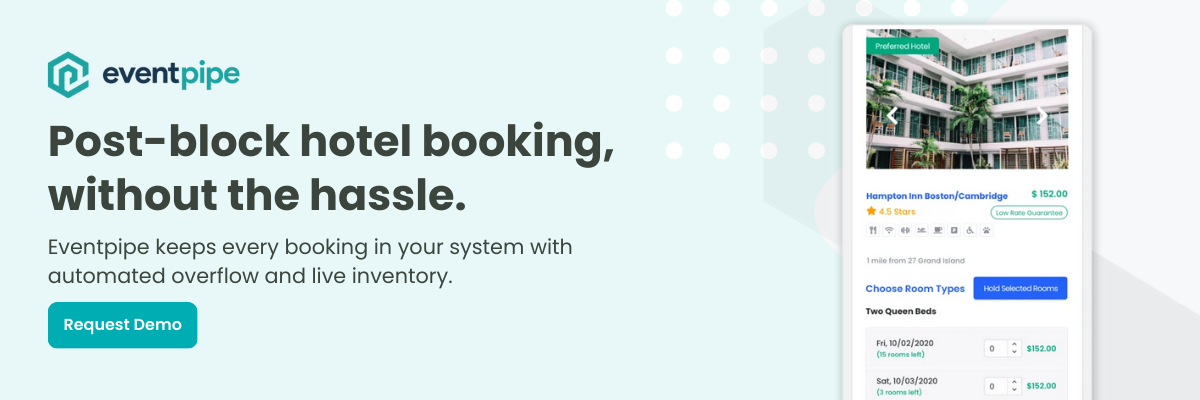

The contracted block is closed, the rate is gone, and the hotel has released those rooms back into general inventory. Teams that missed the window are on their own, booking through whatever channel they find first. That is revenue the housing company contracted for and cannot collect. It is also a support headache: teams calling to ask why the booking link is not working, why the rate is different, or whether there are any rooms left. A post-block booking option solves this by keeping a live hotel link active after the cutoff, pulling from real-time inventory so teams can still book through your channel even after the original block closes.
The two most common reasons are timing and friction. Families who register late assume the official block is sold out and go straight to a travel site without checking. Families who do check but hit a confusing booking experience, a site that does not work well on mobile, or a sold-out message with no alternative option will do the same thing. The housing company loses the booking either way. Most of this is not families actively choosing to go around the system. It is families taking the first path that works.
Start with a booking site that is easy to find and easy to use on a phone, because that is how most tournament families are booking. Then make sure there is always something to offer: a waitlist when hotels fill, and a post-block option when the cutoff passes. The biggest driver of out-of-network bookings is a dead end, a sold-out page with no next step. Give families a path forward that stays within your channel and most of them will take it.
At the same time as everything else. Overflow is not a problem to solve after the block fills; it is a scenario to plan for before the block even opens. Housing companies that wait until rooms are gone to think about overflow are already behind. Set the cutoff date, watch pick-up as registration builds, and have a post-block booking option configured and ready. The goal is that the transition from contracted block to overflow is invisible to the family booking. They click a link, find a room, and book. Whether that room came from a contracted block or live inventory is not their concern.
No. At small tournament volume, a housing manager can track overflow demand through email and phone calls and piece something together. As events grow, that approach breaks down fast. Large tournaments generate overflow inquiries across multiple hotels, multiple room types, and tight timelines, all while the rest of the event is also in motion. Managing that manually means slower response times, missed bookings, and revenue that walks out the door while someone is updating a spreadsheet. The housing companies running large events efficiently have overflow handled by the platform, not by a person making calls.

Jeff is the Marketing Manager at EventPipe. He brings a decade of Marketing experience with a background in social media, events, SEO, and content. Outside of work, Jeff is an independent Hip Hop artist who regularly releases and performs his music and loves to golf and play ice hockey in his spare time. Jeff holds a bachelor of arts in Economics from Union College, with a minor in Spanish.
