
TL;DR
If you manage housing or hotel bookings for youth sports tournaments, you know the pressure. You're balancing tight timelines, limited staff, and fast-moving logistics—all while trying to fill room blocks and keep teams compliant. Hotels, CVBs, and city stakeholders expect results, and missed bookings mean missed revenue.
In 2023 alone, youth sports drove 73.5 million room nights and $10.9 billion in hotel revenue. But that value only counts when teams actually book through your housing process. That's why Stay to Play is so important. Done right, it secures bookings, protects your bottom line, and builds long-term credibility with your partners. Done wrong? You lose teams, leverage, and future support.
This guide is for the directors, organizers, and youth sports housing companies who make it all work behind the scenes. We'll break down what Stay to Play really means in the youth sports world, how to enforce it effectively, and what tools can make it easier to scale, without creating friction for teams or families.
Stay to Play is a policy that requires all teams, athletes, and families to book accommodations exclusively through approved hotels or booking systems designated by the event. That means no off-list hotels, no staying with relatives, and no alternative lodging like RVs (without prior approval). Everyone books through the official housing partner.
These approved hotels are typically located within a designated radius of the venue (often 50 to 90 miles) to ensure convenience for teams while maximizing the event's impact on the local economy.
This structure gives organizers the visibility, control, and data needed to keep room blocks performing, partners satisfied, and operations built for growth.
But that only works if teams actually follow through. That's where Stay to Play compliance comes in.
Compliance measures how well teams stick to your booking requirements. It protects margins, fulfills hotel and city commitments, and keeps your numbers and your reputation on track. When bookings stay in the system, everything runs smoother: operations, contracts, planning, and partnerships.
Here's how it supports event success:
Commission from hotel bookings often funds a large chunk of your event. When teams go outside of the block, that money disappears. The fewer rooms that slip through the cracks, the stronger your margins stay.
Hotels need to see real pickup. If you don't deliver, you could see higher rates or lower block commitments. Strong compliance helps you meet your contractual obligations and maintain a good standing for the next season. Organizers using Eventpipe's hotel booking software can monitor block performance in real time, adjust early, and keep pickup on track without scrambling.
CVBs want proof that your event drives economic impact. Stay to Play compliance gives you the room night data to back it up. That kind of reporting builds trust and often determines whether you get future funding, grants, or in-kind support. When that reporting consistently shows strong room night performance, funding for youth sports programs through city grants and tourism incentives tends to follow.
Clear housing policies help teams plan faster and avoid issues. Centralized booking takes the guesswork out of rates, inventory, and contacts. When everything flows through one system, there's no more chasing confirmations or sorting out last-minute changes.
Strong compliance this year helps you negotiate better terms next year. With real data and high pickup, you're in a better position to ask for lower rates, more comp rooms, or better concessions. Hotels pay attention to those numbers, and the event housing revenue metrics that matter most are all tied to how well you enforce Stay to Play.
When every team books the right way, everything runs more smoothly; revenue holds steady, contracts are met, and the event experience improves.
In youth sports, Stay to Play compliance is a structured process that ensures every team books through the correct channels and stays at approved properties. It's how housing companies maintain control, meet obligations, and deliver consistent results for hotels, cities, and stakeholders. Here's what that process typically includes:
All reservations flow through a single booking platform or housing partner selected by the event. This centralization enables accurate tracking of room nights, prevents leakage, and provides organizers with real-time visibility into hotel inventory and team assignments.
For large tournaments with multiple clubs, venues, or VIP groups, creating sub-blocks (or "team blocks") helps simplify assignments and reduce booking conflicts. These sub-blocks carve out rooms for specific teams or groups within your overall block, helping organizers stay organized, track pickup more precisely, and reduce last-minute scrambles.
Accurate compliance starts with clean registration data. Event organizers typically send registration rosters to the housing company, which then attempts to reconcile team names across systems. Without proper matching, it's difficult to track which team booked where.
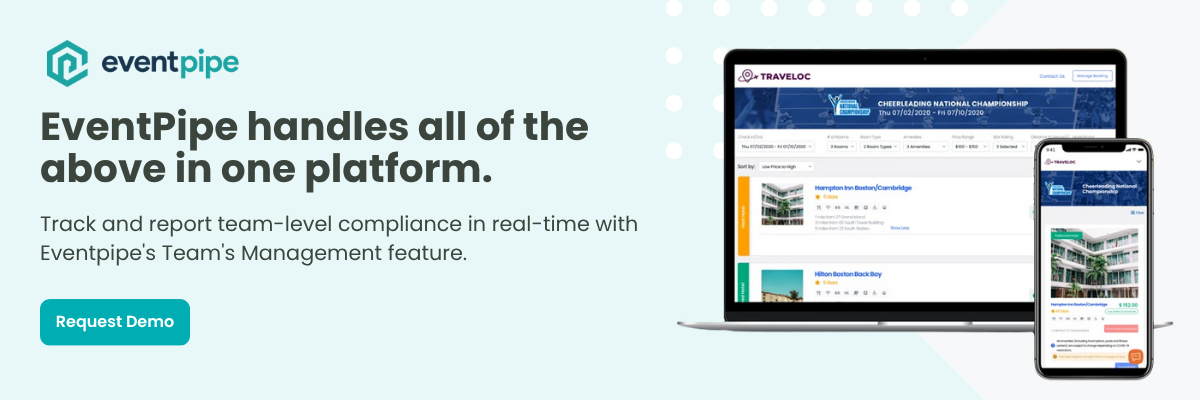
Traditionally, this is a manual and time-consuming process done in spreadsheets. With Eventpipe Teams Management, that reconciliation is automated, linking registration data with booking data in real time, eliminating confusion, reducing admin time, and ensuring compliance tracking is tied to the correct teams.
That same automation lets a housing manager check compliance status any time instead of waiting for a scheduled report to see which teams are still outside the block.
Rooming lists generated by the booking system serve as the official record of which teams have secured housing and where they are staying. These lists help confirm compliance, reduce manual oversight, and support accurate scheduling.
Stay to Play policies often include clear consequences for non-compliance, such as fines, disqualification, or exclusion from game scheduling. These measures are designed to uphold the integrity of the policy and maintain fairness across all teams.
Most Stay to Play policies include a formal process for managing exception requests, such as for local teams or special circumstances. A structured approach ensures that decisions are consistent, transparent, and well-documented.
Clear and proactive communication about Stay to Play requirements is essential. This includes early notifications, reminders, accessible FAQs, and a transparent exception request process to help teams understand and adhere to the policy.
Third-party housing companies manage the compliance process on behalf of tournament organizers. These partners bring the tools, systems, and knowhow needed to monitor bookings, resolve issues, and deliver comprehensive reporting to event organizers and hotel partners.
When teams ignore Stay to Play and book outside your approved room blocks, it can chip away at revenue, relationships, data integrity, and team satisfaction. Compliance determines whether your event thrives or just survives.
Here's what's really at risk when that system breaks down:
Every time a team books outside the official block, you lose out on commissions tied to those rooms. In a 50-team tournament, even just 5% leakage could mean forfeiting $10,000 or more in potential earnings.
That's a major hit. For many youth sports events, housing-generated revenue helps cover essential costs, like staffing, field rentals, and hospitality. When bookings leak out of the block, it limits the resources needed to deliver a high-quality experience for players, coaches, and families.
Hotels operate on trust and performance. If you promise 500 room nights and deliver 200, that's a red flag. Even if teams attend, bookings outside the block can make it appear that your event underperformed. That's how organizers lose access to good rates, prime inventory, and the flexibility that makes large events work.
Once that trust is lost, it's hard to get it back. Hotels prioritize repeatable, compliant business, so if your numbers don't hold up year over year, it becomes harder to secure room blocks that meet your needs.
.png)
When teams go around the system, those bookings disappear from your reporting. You can't tie those room nights to your event, and that makes it hard to show the real value you're driving. It weakens your ability to prove ROI to host cities and hurts your standing with sponsors and stakeholders.
Scrambling to verify bookings, manage exceptions, or chase down confirmations adds stress for everyone. Your staff burns time tracking down details. Teams get frustrated waiting for answers or missing out on the accommodations they want. That friction shows up in surveys, retention rates, and your brand reputation.
A consistent Stay to Play process eliminates that noise. When expectations are clear and bookings are centralized, teams spend less time figuring things out and more time focused on the game.
.png)
A Stay to Play policy only works when it's clear, consistent, and fully enforced from registration through post-event reporting. Whether you're building your policy from scratch or tightening up existing rules, the foundation has to be rock solid.
Below are the five non-negotiables you need to build (or refine) to keep teams in compliance and your housing system running smoothly at every stage.
Start with a clear definition of Stay to Play tailored to your event. Teams need to know exactly what's expected of them from day one. That means: housing is required, and registration isn't complete without it.
To enforce compliance, include:
Example: "Team registration is not complete until official housing is booked." It eliminates confusion and sets the tone early. Then, make enforcement part of the flow by holding schedules until housing compliance is confirmed.
Protect your inventory and your data by locking in the booking process. Teams should only book through your approved platform. No calls to hotels. No third-party sites.
To enforce compliance, make it easy and obvious:
This keeps everything centralized and trackable, reducing leakage and simplifying reporting. Consistency in communication matters, too. Use tools that automate reminders.
.png)
Deadlines help your event stay on track. They cut down on last-minute chaos and set a clear timeline for teams to follow. Publish all booking and audit deadlines early and enforce them with structure.
Key dates to include:
Implement smart enforcement tools to help you avoid conflict:
Not every team will be able to book inside the block—and that's okay. What matters is having a consistent, well-documented process for handling exceptions.
Step 1: Define what qualifies as a valid exception
Create a clear list of acceptable scenarios. Common examples include:
Step 2: Offer a buy-out option for non-qualifying teams
For teams that don't qualify for a traditional exception, offer a buy-out fee instead of forcing them into non-compliance.
Step 3: Use a simple, trackable request form
Keep your request process straightforward:
Step 4: Log all exceptions in one system
Whether it's a radius exemption, a buy-out, or a medical exception, every approval should be documented in a central location. This:
When it comes to enforcement, visibility is power. Manual spreadsheets don't scale, and guessing who's booked where leads to mistakes you can't afford. Real-time compliance tracking is how top-tier events stay one step ahead.
A strong system should:
Reducing leakage starts here. By monitoring block performance in real-time and reallocating inventory as needed, you protect your revenue and maximize your rebate potential.
Automate compliance with dynamic tools like EventPipe. You can set block size restrictions to prevent teams from reserving rooms they won't use. That reduces blockflation, frees up inventory for others, and ensures your event runs at full strength.
Even with strong policies, small adjustments can make a big impact. These proven tactics help reduce leakage, increase compliance, and keep teams on track from the start:
.png)
Running a successful Stay to Play tournament comes down to clarity, systems, and consistency. This checklist will help keep your operations tight and scalable as your event grows:
If you're looking to grow your event and protect every dollar, this is where you start. Build your policy. Back it with tools. And stay in control from the first booking to the final report. Book your Eventpipe demo today and see how effortless Stay to Play compliance tracking can be.
.png)

Scott Villemain is a product and solutions leader with over two decades of experience translating complex business challenges into scalable technology. As Product Manager at EventPipe, he has been instrumental in developing the thinking behind blockflation — the tendency for youth sports travel teams to over-reserve hotel rooms, blocking more than what they realistically need — and building tools that help event operators run fairer, more transparent Stay to Play programs. With prior leadership roles as Chief Product & Technology Officer and Senior Director of Product Management across SaaS and tech-enabled services companies, Scott brings a seasoned practitioner's perspective to one of youth sports travel's most misunderstood issues. He holds a Bachelor of Science in Management Information Systems with Honors from the University of Georgia's Terry College of Business.
