
TL;DR
Venue sourcing has changed. Fast. Five years ago, planners had time to walk hotels through the details: how your agenda was structured, what kind of space setups you needed, how room pickup looked in past years, and why certain dates or patterns mattered. Today, most event requests are submitted through a brief, digital request for proposal (RFP) that summarizes your meeting space needs, room blocks, and event goals. Hotels are flooded with them.
According to EventPipe data, over the last five years:
Hotels are overwhelmed. To get real consideration, planners need to make it easy for hotels to quickly see fit and value.
One key metric helps you do that: rooms to space ratio. In this guide, you'll learn how to calculate it, improve it, and use it to stand out in a crowded pile of RFPs.
That number is only one input into the full hotel sourcing and booking process, alongside RFPs, contract terms, and pickup tracking, that ultimately determines whether your event turns a profit.
Rooms to space ratio (RSR) measures the relationship between the meeting space your event needs and the number of hotel rooms you expect to book. Hotels rely on this number to gauge whether your group brings the right mix of space use and revenue potential. It's one of the fastest ways they assess event fit.
Planners who understand their RSR give hotels a clearer picture of value. A low ratio often suggests higher space needs relative to room nights, which makes the event harder to book. A higher, more balanced ratio can improve how your RFP is received.
How hotels typically interpret RSR:
The number itself matters, but context is just as important. Events that explain their RSR with history, flexibility, and space setup make better partners for hotels.
Whether you're sourcing hotel meeting space for a national convention or a mid-size summit, knowing your rooms to space ratio is key. It's simple math and helps hotels evaluate your request quickly.
Gather two inputs:
Divide the total meeting space by the number of sleeping rooms per night.
Example:
Include this number in your RFP. It makes your request easier to evaluate.
There's no one-size-fits-all benchmark for RSR as hotels vary widely in how much meeting space they have relative to their room count. A 500-room hotel in one city may have double the meeting space of another with the same number of rooms.
Instead of guessing, ask the hotel directly: "What's your preferred room-to-space ratio?" That gives you a realistic benchmark to compare your event against.
If you want to calculate your RSR manually, here's how:
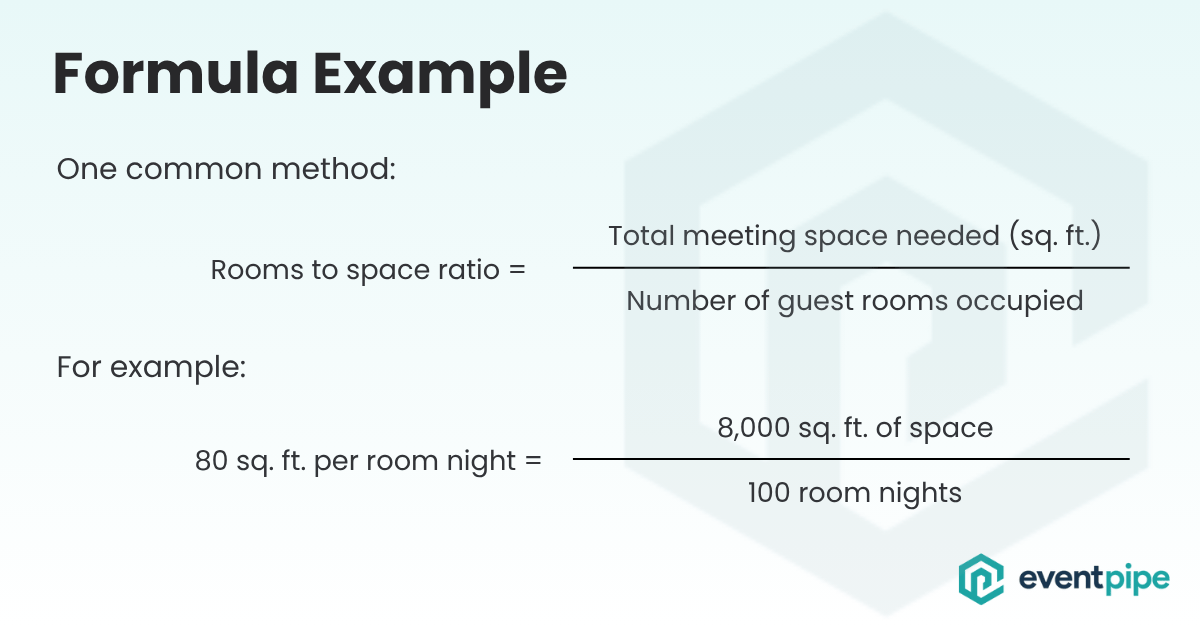
This is typically within range for many full-service hotels, but always verify with the property. If your RSR is on the high side, use your RFP to explain why. Long agendas, lots of breakouts, or a spread-out room block can all justify more space.
Hotels are inundated with RFPs, many of which are rushed, transactional, and lacking key context. That's why hotel teams use quick metrics to evaluate whether an event is worth pursuing. Your rooms to space ratio is one of the first things they look at.
When your RFP hits a hotel's inbox, their sales team asks one key question: Can we sell out the rest of our rooms if we give up this space? Meeting space is valuable, but only if it helps drive sleeping room revenue. That's the real commodity.
A strong, clearly explained RSR helps hotels quickly assess the opportunity. If your ratio is too high (meaning you're asking for a lot of meeting space without enough rooms to offset it), you're more likely to get passed over, especially in peak season. Seasonality impacts how hotels evaluate your RSR.
Where the ratio lands also drives the quote, since hotel meeting room costs climb fast when the space you are asking for outweighs the block you can fill.
Peak season (e.g., Orlando in February):
Off-season (e.g., Orlando in August):
A clear RSR helps hotels qualify your event fast. The better your RSR, the better your chances.
RSR gives hotels a fast read on whether your event aligns with their business model. It tells them:
Strong RSR = better fit = faster response.
Even if your event is a great fit, poor positioning can cost you. The most common RFP red flags include:
To quickly assess your event's potential, hotel sales teams look for:
When you lead with a strong, well-contextualized rooms to space ratio, you're making it easier for hotels to say yes and easier for them to advocate for your event internally.
Association events don't follow the same patterns as corporate meetings, and hotels know it. Agendas are longer, space needs are higher, and attendee behavior is more varied. These factors can make your rooms to space ratio look less efficient, even when your event is a great fit.
That's why it's important to explain how your event works and where the value really lies.
Association events tend to include:
These differences require added context so hotels can evaluate fit accurately.
If your RSR is higher than the typical corporate meeting, that's okay. Just help hotels see the full picture:
This clarity helps hotel teams confidently advocate for your event internally.
Meeting the numbers matters, but explaining them is what gets results. Especially for association events, your rooms to space ratio might not tell the full story. Without added context, hotels could easily overlook an event that's actually a great fit.
This is where planners can take control. The 10 strategies below help you clarify your value, support hotel sales teams, and earn stronger, faster responses.
Hotels are selling meeting space before anything else. Your job is to help them sell your event internally. According to MPI's Hotel Sales Trends report, 63% of hotel sales reps cite "internal justification" as a key factor in prioritizing RFPs.
Help hotels evaluate your event faster by including:
Don't bury the number that matters most. Calculate your RSR up front using average square footage per person, typically 20–25 sq. ft., depending on room setup. Put that math in your RFP.
Space per person benchmarks:
Source: Special Events
Help hotels see the bigger picture with real numbers, as events with three or more years of history receive 27% faster responses. Include pickup history, space usage, and past attendance. Hotels use this to forecast staffing, revenue, and space availability.
Small adjustments can make a big impact. Being flexible with room setups, shoulder nights, or schedule blocks gives hotels more ways to say yes. In fact, flexibility is one of the top factors in unlocking better space and pricing.
Areas to flex:
Avoid mass-blasting 20 hotels (targeted RFPs receive 30% higher-quality responses). Instead, focus on six to eight that meet your core needs. It improves the quality of proposals and builds better hotel relationships.
Why fewer RFPs = better results:
With the right hotel RFP tools in place, you can automate parts of the process, streamline follow-ups, and keep your outreach tight and intentional without losing visibility or control.

Let hotels know when you plan to decide. And how. This creates urgency and helps them prioritize your request.
What to include:
Timing is everything, so don't overload hotels in your initial request. Instead, start broad, then go deep. A phased approach boosts hotel engagement and improves final proposals.
Early-stage RFPs should ask for:
Later-stage RFPs (when shortlisting) can request:
Hotels deprioritize silent RFPs. Even a quick status update helps maintain interest. RFPs without engagement for five or more days risk dropping in priority.
Best practices:
Always communicate your final decision, win or lose. It builds goodwill and increases your chances of stronger proposals next time.
When declining, include:
Your RSR, event history, and planner tone all signal how easy your event will be to support. Events with clear documentation are 2.5x more likely to be selected by hotels. When hotels see clear, complete, and collaborative details, they respond faster and more favorably.
To make your event easier to book:
.png)
Your rooms to space ratio reflects your entire housing strategy. How you block, track, and communicate hotel data directly affects how venues interpret your event. Small, focused changes can shift how hotels respond to your RFP.
Tightening convention housing around fewer, better-matched hotels is one of those changes, since concentrated pickup reads as stronger demand to a hotel.
Dispersed blocks make your pickup look weaker. When hotels see concentrated demand, they can better assess value.
Housing agreements can create value without raising attendee costs. Structure your deals with hotels to include rebates, value credits, or tiered incentives.
Static contracts don't reflect what's actually happening. Tools like EventPipe help you monitor room performance as it happens, not weeks later.
Planners who communicate early and clearly earn better attention. Keep hotels updated if something changes, especially if it improves your RSR.
Hotels prioritize events with realistic expectations and clear value. The RSR is a shared metric, and context builds trust.
Be upfront about:
Transparency helps hotel partners understand your needs and support your event with confidence.
.png)
Rooms to space ratios tells hotel teams how your event fits their space, their revenue goals, and their internal priorities. When the ratio is clear (and backed by context) your RFP becomes easier to evaluate, easier to pitch internally, and easier to approve.
The strongest RFPs don't just meet room and space needs. They make the hotel's job easier. When you show your value up front, hotels move faster, negotiate more openly, and treat your event like a priority.
Want to make that happen every time? Request an EventPipe demo to calculate, track, and communicate your rooms to space ratio the way hotels want to see it.
.png)
Rooms to space ratio measures how much meeting space your group uses relative to the number of hotel room nights you book. It's calculated by multiplying total seats by 20–25 sq ft (depending on setup), then dividing by the number of rooms used per day.
Hotels prioritize groups that use meeting space efficiently and generate strong room revenue. A lower rooms to space ratio (under 90 sq ft/room) typically means your event is more profitable for the venue, which can lead to better pricing, space availability, and concessions.
A strong rooms to space ratio is less than 90 square feet of meeting space per guest room night sold. That's the benchmark most hotels look for when evaluating RFPs.
Association meetings often have lower in-block room pickup and more breakout space needs than corporate events. This can increase your rooms to space ratio, but you can offset that by sharing history, adjusting housing strategy, and using data to show event value.
Consolidate room blocks, reuse meeting spaces, optimize setup styles, and track real-time pickup. Use tools like EventPipe to calculate and communicate your RSR clearly to hotel partners.

Jeff is the Marketing Manager at EventPipe. He brings a decade of Marketing experience with a background in social media, events, SEO, and content. Outside of work, Jeff is an independent Hip Hop artist who regularly releases and performs his music and loves to golf and play ice hockey in his spare time. Jeff holds a bachelor of arts in Economics from Union College, with a minor in Spanish.
