
A hotel pickup report shows how many room nights from a contracted group block were booked and used, compared with what the contract promised the hotel. For anyone holding a block, whether a housing company or an organizer who contracts hotels directly, that number decides attrition fees, comp rooms, commissions, and rebates.
The metrics worth tracking are pickup percentage, pickup by night, booking pace, pickup by property and room type, reserved vs. actualized room nights, outside-the-block leakage, post-block bookings, and commission realization.
A hotel pickup report compares the rooms in a group block against the reservations made and the stays that happened. The Sports Events and Tourism Association defines room pickup as the number of rooms occupied out of the total reserved.
Take a closer look at most pickup report guides, and they describe the hotel's version, which uses the same math to answer a different question:
Hotel pickup matters because it controls the money on both sides of the hotel contract:
Each metric answers a different question.
Pickup percentage = room nights picked up ÷ room nights contracted
A 400-room-night block with 340 actualized nights sits at 85%. Compare it to the contract's attrition threshold. For events that open bookings far in advance, a monthly check works until the final 90 days.
A strong total can still cost money. In a Northstar Meetings Group Q&A on attrition, attorney Jonathan Howe walks through a three-night block that hit its total:
Under nightly attrition terms, the hotel can still charge for night 1, since extra rooms on night 2 can't refill empty ones. Watch peak night, which holds the largest share of the block. Track pickup by stay date and know whether your contract counts attrition nightly or cumulatively.
Booking pace compares current pickup to where the same event stood at the same point last year. Pace is your earliest warning. If pickup trails the previous year 60 days out, send a cutoff reminder or run targeted promotions to registered teams that haven't booked. Pickup trends across events also help you forecast block size and budget.
Trade fairs and other local events on the same weekend drain market inventory and send guests hunting for the lowest rate.
On multi-hotel events, one hotel can sit at 95% while another sits at 60%. A property-level view helps identify where to release rooms before attrition becomes a risk. If you notice doubles sold out while kings sit empty, ask the hotel about availability to shift the mix. Room block management software can roll pickup up across every property into one report.
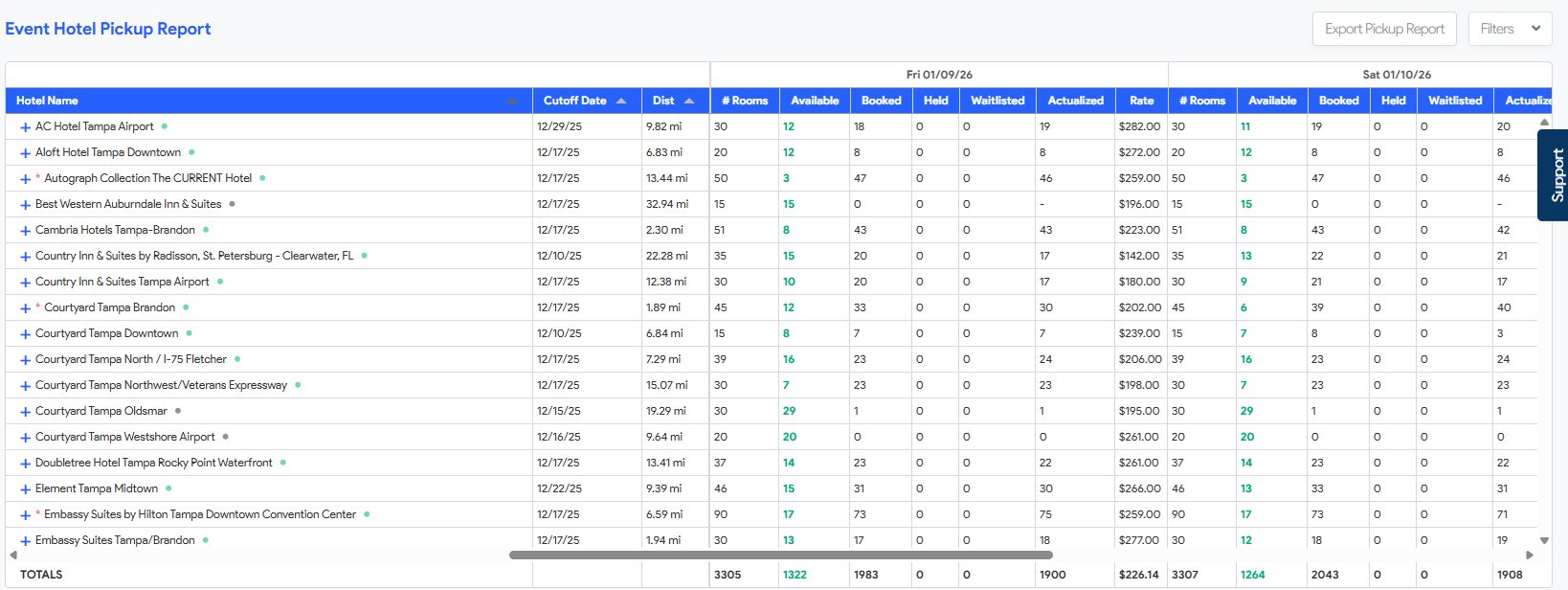
Teams often reserve extra rooms to secure inventory, then cancel or no-show late. EventPipe calls this blockflation. The block looks full on the booking site, then shrinks at reconciliation along with the commission. Track the net change between room nights booked and room nights actualized for each group.
“A block that looks 95% picked up can still be hiding blockflation, and the tell is usually in the details of the pickup report, not the headline number. I look for duplicate names, reservations with no guarantee behind them, bookings stacked on one night, and a cancellation count that is quietly climbing. Plenty of teams see the percentage and relax, but a pickup number only counts if each room is tied to a real attendee who will actually show up. Before the rooming list goes to the hotel, I match every reservation against the registration list, clear out the duplicates and placeholders, and confirm any big batches booked by one person. That way the hotel gets a clean list, and the wash on the final bill reflects rooms that were truly used, not rooms that only looked full.”
Patricia Driscoll, Director of Customer Success and Support
Some of your demand never touches the block. A joint study from ASAE, CEIR, MPI, and PCMA covering more than 170 events found that 34.1% of rooms were booked outside the contracted block on average (published in 2015). In youth sports, Stay-to-Play compliance tracking matches bookings to registered teams and flags leakage before cutoff.
Demand keeps coming after the cutoff date. Live inventory tools such as EventPipe's Presto keep late reservations on the same event record, so the report shows total demand.
Compare contracted terms, invoiced amounts, and payments received. Reconciled numbers determine what you can invoice. Most gaps trace back to manual data entry.
See pickup by hotel and by night in one view. Book a demo.
Analyze pickup at three points: before cutoff, at cutoff, and after the event.
“At cutoff, the first number I check is pickup against the contracted block for each night, not the overall total. A strong peak night can make the whole block look healthy while the shoulder nights sit well short, and under a per night attrition clause every one of those short nights costs you. If a night is trending more than 10 to 15 percent under its contracted count with no registrations left to book, I call the hotel that same day to release those rooms before the cutoff passes. If one property is full and another has open rooms, I ask to shift the extras across properties instead of letting them go. The goal is to give rooms back while it’s still free to do so, because after cutoff you can’t release them, and the wash is where that mistake shows up.”
Patricia Driscoll, Director of Customer Success and Support
Reconcile a pickup report by matching every reservation the block produced against what each hotel confirms guests used, then invoicing commissions and rebates on the confirmed number. Hotels report actuals in one of two formats:
With every event and hotel in one account, hotel reconciliation software keeps the numbers in one system from booking to invoice.
Real-time pickup data gives housing companies a live overview of every block.
JPG Travel Solutions owner Paula Gravatt said: "I love the ability to see room night pickup. This allows me to quickly answer my client's questions about the room block, provide better customer service to travelers and event attendees, and estimate profits for both me and my clients."
Hotel partners were asking TeamINN for better reporting. After moving to EventPipe, the team got a dashboard with reservation metrics, pacing insights, and historical performance. Results included expanded room blocks and nearly 80% year-over-year growth.
INNplay founder Erica Lasky credits PipeSights with giving her team "real-time data on reservations, room blocks, and financials."
Hotels set your next group rate, concessions, and attrition terms from what your event delivered. Bring clean, actualized pickup data to the next RFP, then use it for data-driven decisions on block size and to push for more revenue per room night.
“I build the next RFP on what actually picked up last year, night by night, and not on the block we contracted. If we contracted 500 rooms on the peak night but only 380 were used, I ask for 380 plus a reasonable cushion, and I send the hotel the pickup report to back it up. Most people treat history as something to hide when it falls short, but a clean record of real pickup is the best leverage you have. Hotels take that kind of proof seriously because it lowers their risk, so they are far more willing to agree to a smaller block, a lower attrition percentage, or a cumulative clause instead of per night. You end up with a contract that matches how your attendees really book, so you are no longer paying penalties on rooms nobody was ever going to use.”
Patricia Driscoll, Director of Customer Success and Support
See how EventPipe tracks pickup from first booking to final invoice. Request a demo.
Many hotel contracts require groups to pick up roughly 85% to 90% of the contracted room nights. The exact number is negotiated in the attrition clause.
Wash is the share of a block that goes unused, the inverse of pickup percentage. Hotels factor expected wash into how many rooms they hold. A history of low wash makes a strong case for a bigger block next year.
A rooming list is the roster of booked guests sent to the hotel before arrival, usually about two weeks out. A pickup report comes after the event and shows which of those reservations turned into actual stays.

Jeff is the Marketing Manager at EventPipe. He brings a decade of Marketing experience with a background in social media, events, SEO, and content. Outside of work, Jeff is an independent Hip Hop artist who regularly releases and performs his music and loves to golf and play ice hockey in his spare time. Jeff holds a bachelor of arts in Economics from Union College, with a minor in Spanish.
